Public Records Search: How to Search, Tools, and Limits
Stanley Wiggins
July 17, 2026
9 min read
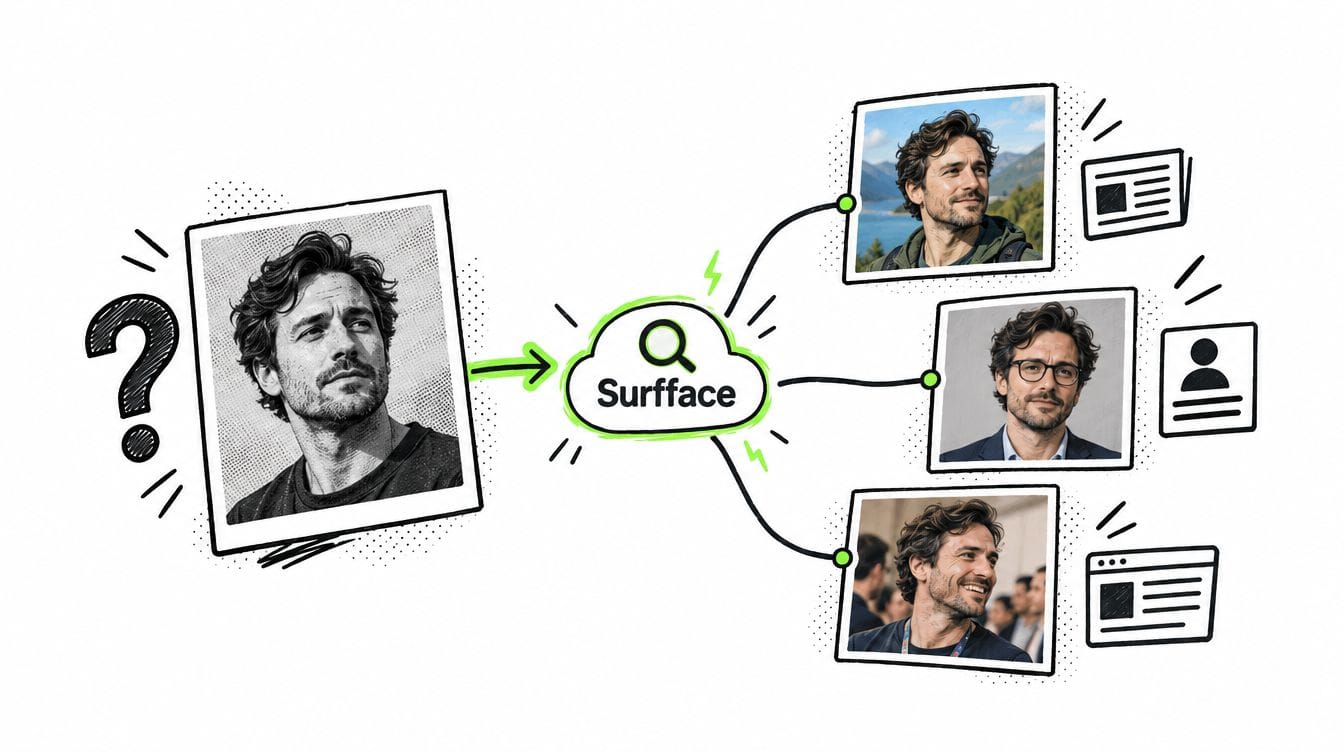
Public records search is useful, but it usually depends on having the right name, location, or identifying details. That becomes difficult when a name is unknown, fake, misspelled, changed, or too common. Surfface helps close that gap by letting users start with a face photo instead. It searches public web sources, social profiles, and available U.S. public records to surface possible matches when text-based search is not enough.
From there, it helps to understand what public records search can and cannot do.
A public records search can help you find information from government records, public databases, court systems, property records, registries, and people-search tools. But it is not one simple search. Public records are spread across federal, state, county, city, court, law enforcement, and registry systems. Some records are easy to search online. Others require the right agency, the right jurisdiction, or a formal request.
That is why a strong public records search usually combines several methods: name search, phone search, address search, email search, court record lookup, registry search, people-search tools, and, when you only have a photo, face search.
As noted earlier, names are not always reliable. They can be fake, misspelled, changed, too common, or not detailed enough to identify the right person. In those cases, Surfface face search for public records can help by starting with a photo instead of relying only on text-based information.
What is a public records search?
A public records search is the process of looking for records that are legally available to the public. In the United States, this can include court records, property records, business filings, jail or inmate records, sex offender registries, vital records, and other government-held records, depending on the jurisdiction.
FOIA (The Freedom of Information Act) gives the public the right to request access to federal agency records, but federal agencies can withhold information under exemptions that protect interests such as personal privacy, national security, and law enforcement. FOIA also applies to federal agencies, not every state, county, court, or private database.
This matters because "public records" and "people search" are related, but not identical. A public record search usually means searching official records. A people search is broader. It may combine public records, contact data, social profiles, public web results, address history, phone data, email data, and other available signals into a single report.
What can you find in public records?
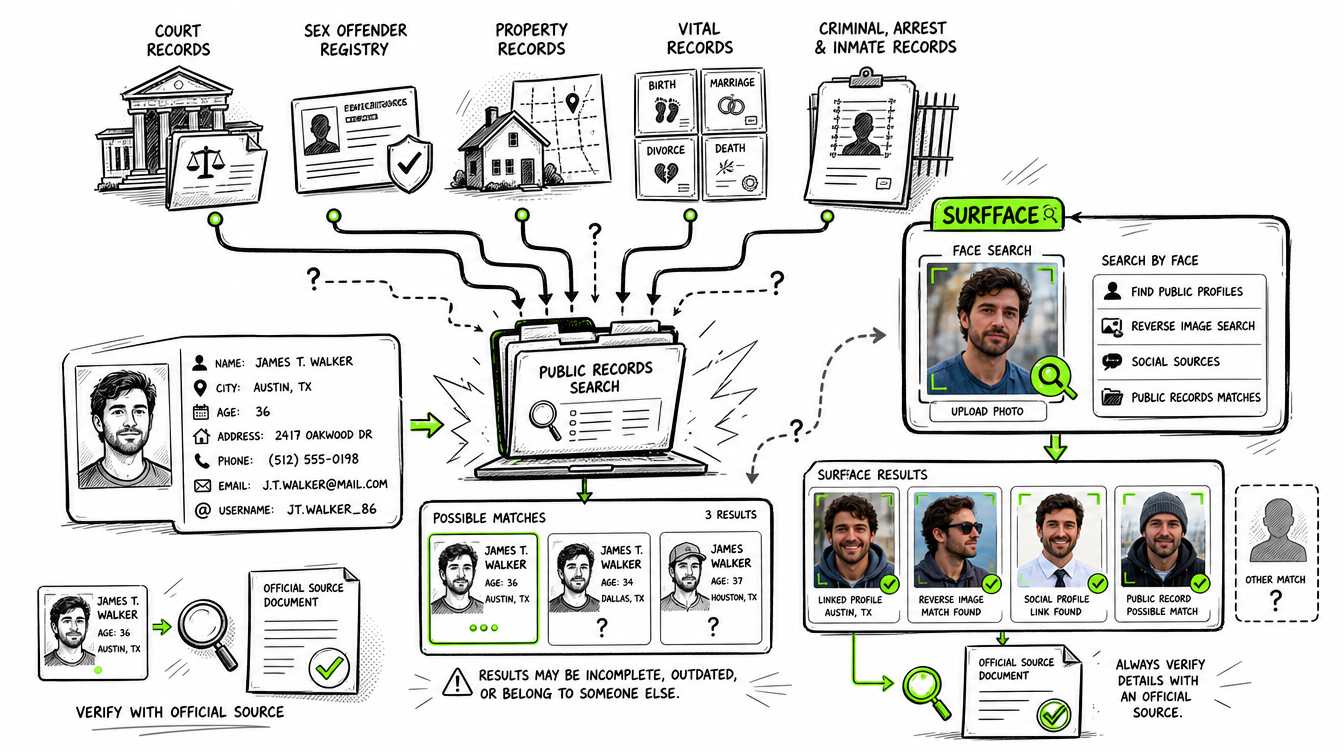
The available information depends on the source. Common public-record categories include:
- Court records. Federal court records can be searched through PACER. PACER lets users search federal court records by a specific court or through a nationwide index, but each court maintains its own case information.
- Sex offender registry information. The Dru Sjodin National Sex Offender Public Website, also known as NSOPW, links public state, territorial, and tribal sex offender registries in one national search site. It supports search by name, ZIP code, city, county, address, or jurisdiction where those options are provided by the jurisdiction. Note that the results should be verified through the individual jurisdiction's registry website. Surfface offers a dedicated sex offender face search and check.
- Property records. County assessor and recorder offices often provide property ownership, parcel maps, recorded documents, deed information, liens, and assessed values. For example, San Diego County states that property ownership, parcel maps, and other property information are available to the public.
- Vital records. Birth, marriage, divorce, and death records are handled by state or local vital records offices or clerks. USAGov explains that certified copies usually require contacting the relevant state, territory, county, city, or vital records office, and the requester may need specific details such as the city, county, date, or place of the event.
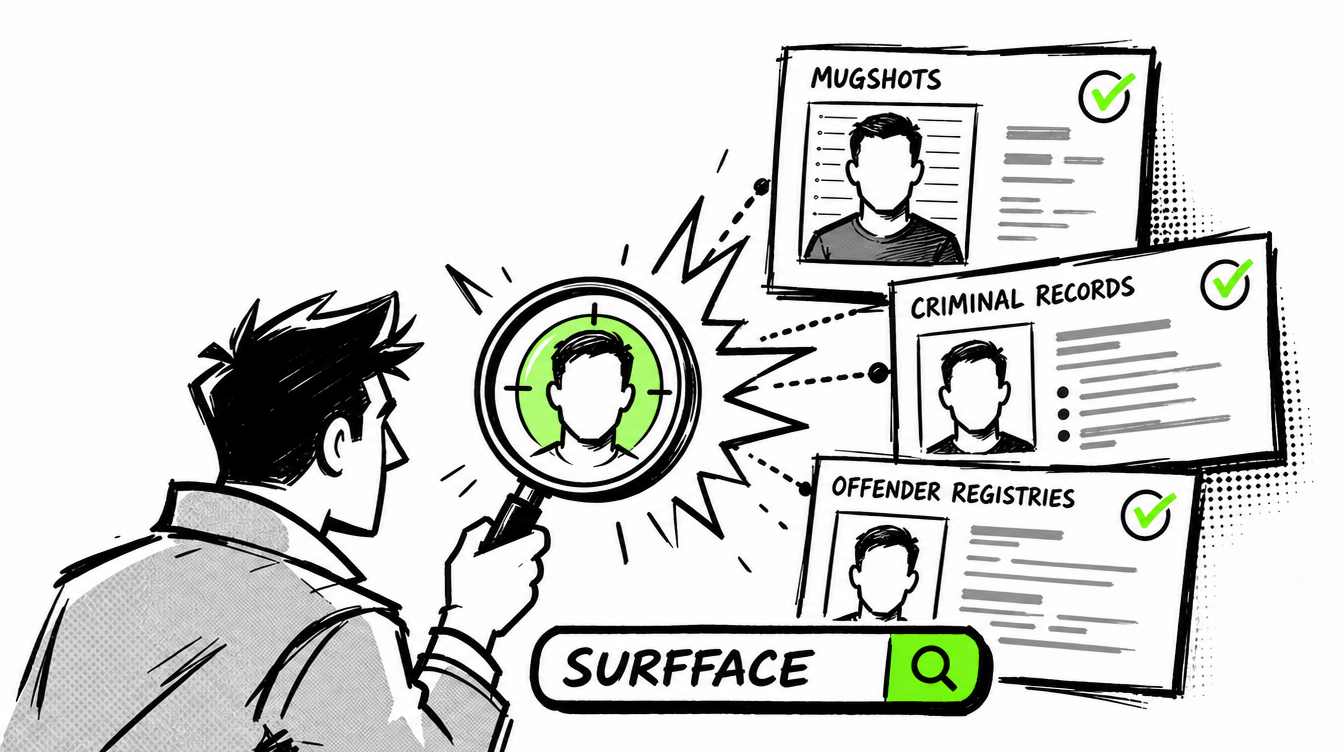
- Criminal, arrest, and inmate records. These may appear in court systems, sheriff databases, jail rosters, police releases, or state repositories. Availability varies sharply by location. A mugshot or arrest record is not proof of guilt, and official sources often require verification through court records or agency records. Surfface also offers a dedicated mugshot and criminal records face search.
How to search public records
Start with official sources when accuracy matters
Use federal court systems for federal cases, state court portals for state cases, county assessors for property information, state vital records offices for birth or marriage records, and NSOPW for sex offender registry searches. Official sources are often the strongest verification layer, even when they are harder to search.
Use more than one identifier
A name alone can be too broad. Add city, state, age range, middle name, prior address, phone number, email, username, or known relatives when available. This helps separate people with similar names and reduces false matches.
Use people-search tools for convenience
Tools like Spokeo, TruthFinder, BeenVerified, Whitepages, PeopleFinders, Intelius, and Instant Checkmate can help aggregate records and identifiers into easier search flows. They are useful for searches by name, phone number, email, address, or property. However, they are not official record sources, and their results can be incomplete, outdated, or matched to the wrong person.
Use face search when text search is weak
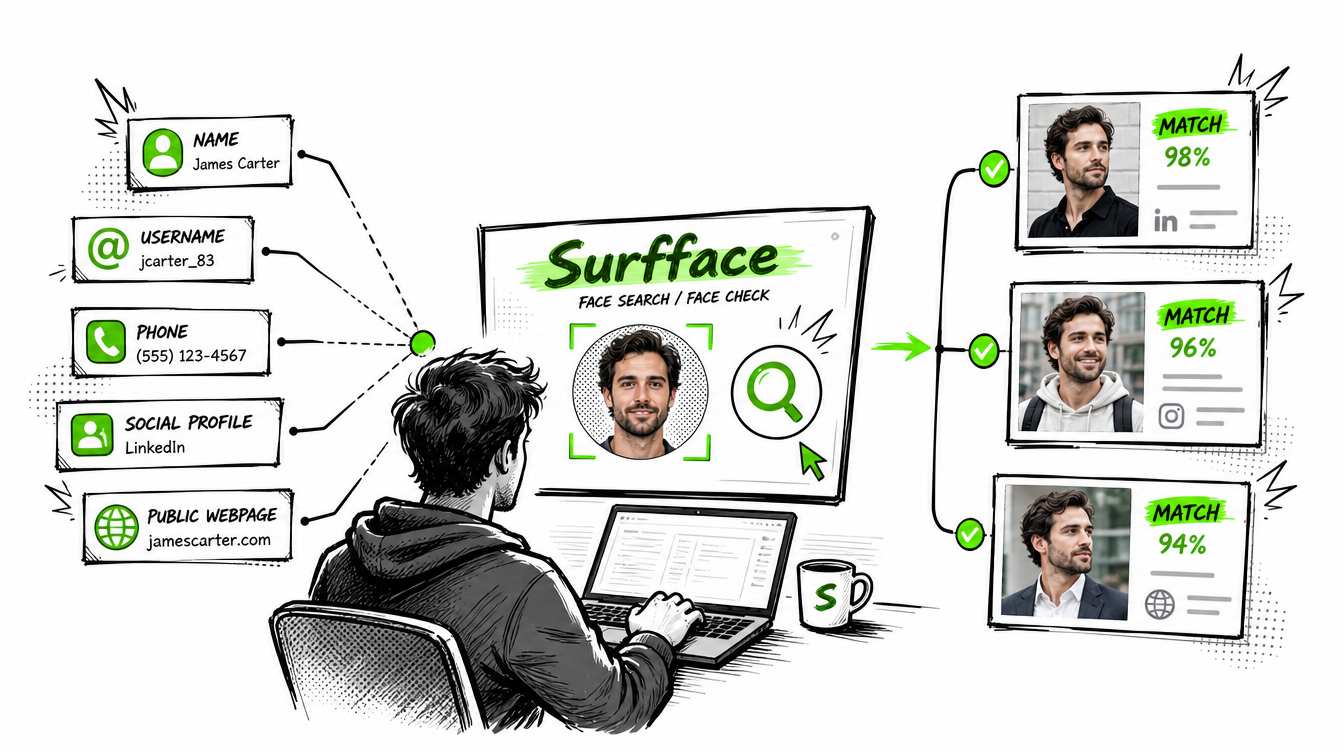
A name can be fake, misspelled, common, outdated, or missing. Face search can help when you only have a photo or when someone may be using another person’s images. Surfface is built for this workflow: users can upload a photo and search across public profiles, reverse image matches, social sources, and available U.S. public records. Surfface uses publicly available information and may use facial recognition only where legally allowed, relying on non-biometric methods in other cases.
Free public records search: What is actually free?
A free public records search is possible, but "free" usually means more manual work. Many official portals are free to search, such as some court websites, county assessor pages, business registries, and public sex offender registries. NSOPW is a public government search site, and many county property tools provide some data without payment. Some sites advertise people search free public records options, but they often provide only limited previews unless you pay or create an account.
The limit is fragmentation. One county may provide online records. Another may require an in-person request. One court may expose docket information online. Another may require a clerk request. Vital records often require proof, fees, or specific eligibility. A public records search free of charge can work, but it may take more time than using a paid people-search tool.
Paid tools usually charge for convenience, aggregation, and report formatting. They may save time, but they should not replace official verification.
Why names are not always enough
Name search is the default method for many public-record systems, but it has major limits. Common names create false positives. People change names after marriage or divorce. Records may use initials, aliases, nicknames, misspellings, old addresses, or incomplete middle names. Some databases are updated slowly. Some records are sealed, expunged, restricted, or not published online.
Even official tools show this problem. PACER recommends searching the specific court if you know where a case was filed, or using the PACER Case Locator if you do not. It also notes that each court maintains its own case information. NSOPW's search criteria depend on what each jurisdiction provides and that users should verify results through the individual jurisdiction's public registry website.
This is why a stronger public record search usually combines name, location, phone, email, address, public registries, and photo-based discovery when available.
Popular public records search tools compared
Where Surfface fits in a public records search
Most people-search tools are text-first. They work best when you already have a name, phone number, email, address, or property. Surfface is different because it starts with a face photo.
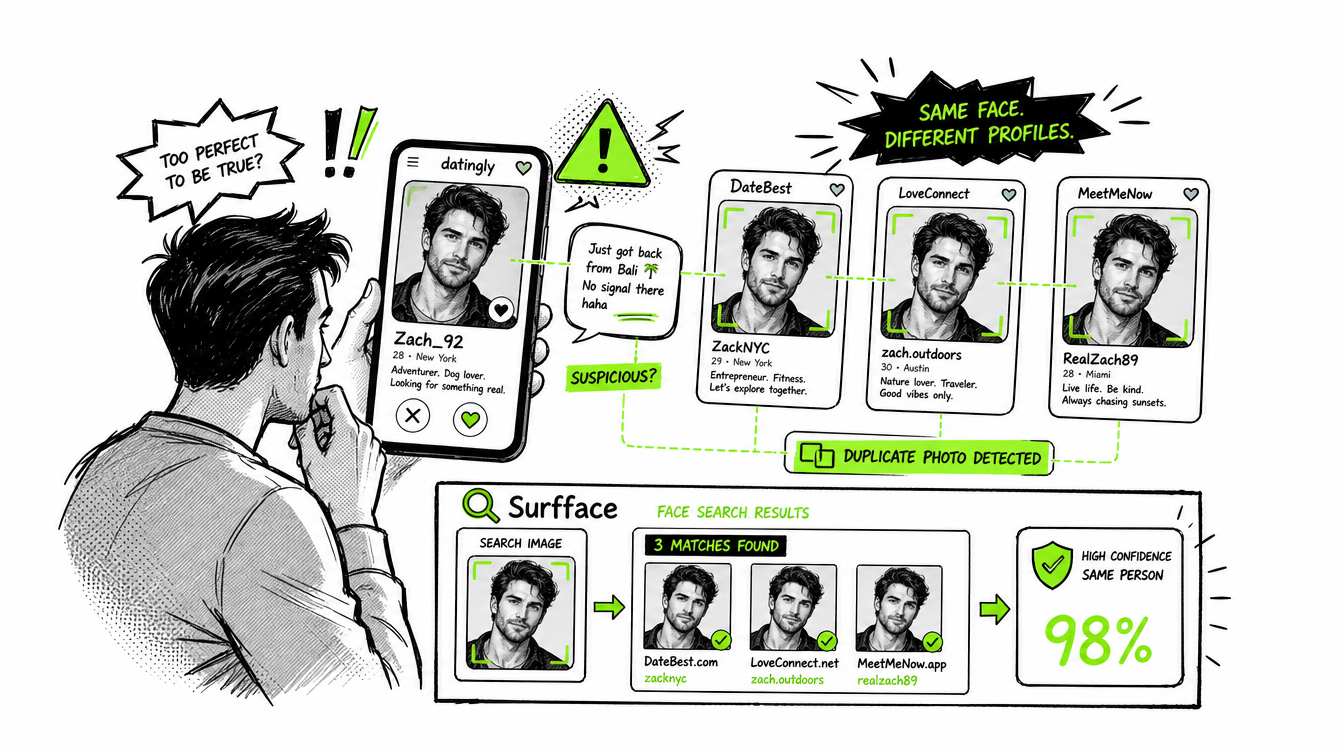
That matters in real-world checks. A scammer can use a fake name. A dating profile can use stolen photos. A person can use an old alias or a partial name. A name search can return dozens of similar people. In those cases, searching by face can create a different path: where does this face appear online, what public profiles use it, and whether it appears in public-source contexts worth checking further.
Surfface should not be treated as an official record source or a legal background check. It is better understood as a discovery layer. It can help surface public matches and context from a photo, then the user can verify important findings through official public records, registries, courts, or agencies.
Limits of public records search
Public records are not always complete. Some records are offline. Some are restricted. Some are sealed or expunged. Some are delayed. Some contain errors. Some are public in one state but limited in another.
A search result is also not the same as a conclusion. An arrest record is not a conviction. A similar name is not proof that two records belong to the same person. A face match is a lead, not a legal determination. A people-search report is not an official government record.
There are also legal limits. If you use consumer reports for employment decisions, you must comply with the Fair Credit Reporting Act, including notice, written permission, and adverse-action steps. Employment background checks can include information from sources such as credit reports and criminal records, and they are treated as consumer reports in that context.
Surfface service and information may not be used for consumer credit, employment, insurance, tenant screening, or other purposes requiring FCRA compliance, and that Surfface does not provide consumer reports or act as a consumer reporting agency.
How to search public records responsibly
Start with the purpose. Are you trying to reconnect with someone, verify a suspicious profile, check your own online presence, review property data, or verify a public registry result? The purpose determines the right tool.
- Use official sources for confirmation. People-search tools and face-search tools can help you discover leads. Official records should confirm important findings.
- Check multiple identifiers. Match name, location, age, date, photo, address, phone, email, and source context before assuming a result belongs to the right person.
- Respect legal boundaries. Do not use non-FCRA tools for employment, housing, credit, insurance, or other eligibility decisions. Do not treat public-record results as complete, final, or proof of character.
Use face search as a complement, not a replacement. When a name search fails, a face search can help uncover public appearances, reused profile photos, and public-source context. Then you can verify the lead through the proper official source.
Q&A
Public records search is useful, but it has limits. Names are not always enough. Free public records search can work, but it is often fragmented. People-search tools can save time, but they are not official sources. Face search can help when you only have a photo or when a name may be unreliable.
The strongest workflow is layered: search official records, use people-search tools for context, use face search when text identifiers are weak, and verify important findings at the source.

Stanley Wiggins
Stan leads product marketing at Surfface, bringing a mix of experience in OSINT and private investigations, along with expertise in digital marketing and product management.