Facial Recognition Explained: Technology, Benefits and Online Face Search
Stanley Wiggins
August 26, 2026
9 min read
You look at your phone and it unlocks. No password. No fingerprint. Face ID compares your face with a stored reference and confirms that you are the authorized user.
This everyday action takes only a second but it shows the practical value of facial recognition. The technology can make identity checks faster, reduce friction, detect possible fraud and help find visual information that would be difficult to discover through names or keywords alone.
Facial recognition uses AI to detect, analyze and compare faces in photos or video. It can verify whether two images show the same person, search a database for possible candidates or help find where a face appears online. Related facial analysis can also estimate age, gender presentation and visible characteristics such as glasses, facial hair, hair color and face shape.
When a photo is your only clue, Surfface offers an easy starting point by combining its own index with Google Images, Yandex Images and specialized face search tools.
What is facial recognition?
Facial recognition is technology that analyzes a face and compares it with other faces.
A typical system detects the face, aligns important features such as the eyes and nose, converts the face into a mathematical representation then compares that representation with one or more other faces.
The result is usually a similarity score rather than guaranteed identification. A high score means that two images may show the same person. Names, dates, locations and source context are still needed to confirm the match.
Facial recognition is used in phone unlocking, identity verification, access control, photo organization, fraud prevention and online face search.
What can facial recognition do?
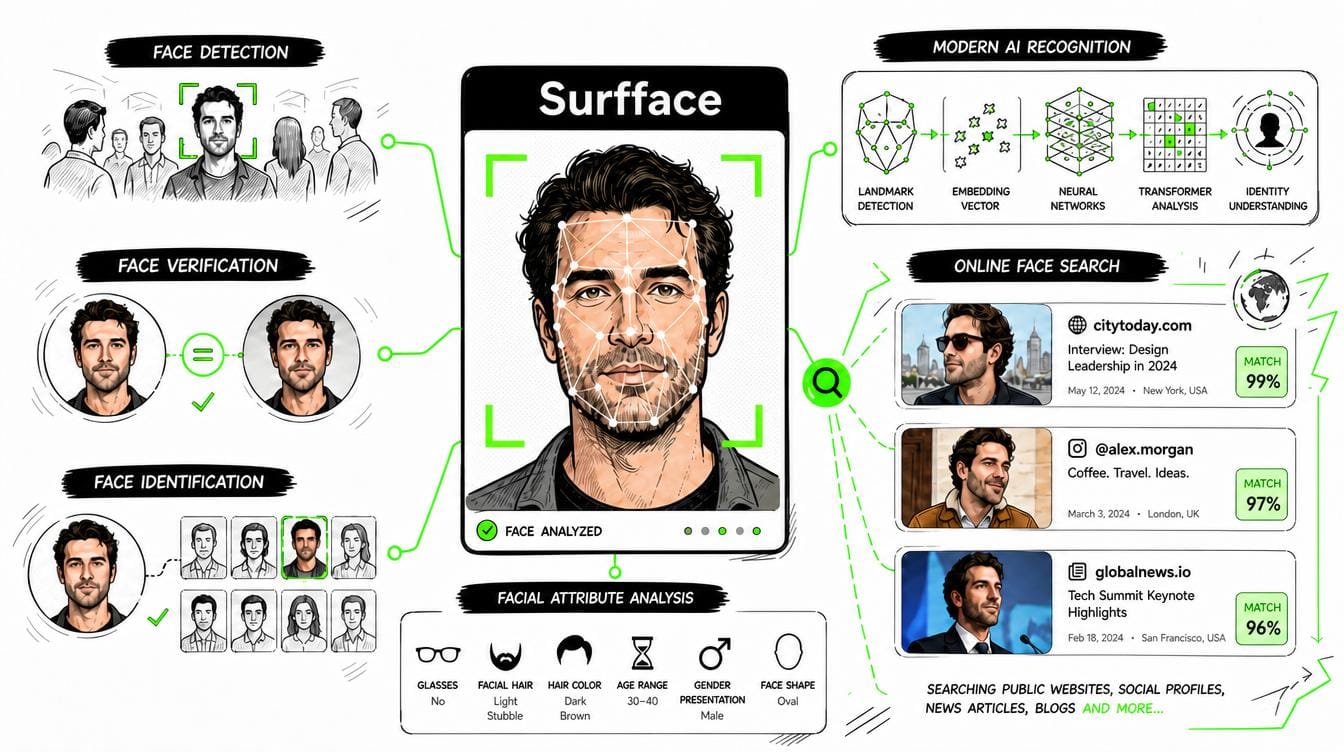
Facial recognition is often used as a broad term for several related technologies.
- Face detection finds a face inside a photo or video.
- Face verification compares two faces to determine whether they likely belong to the same person. Face ID and identity-document checks are common examples of this one-to-one approach.
- Face identification compares one face against a larger database to find possible candidates.
- Facial attribute analysis estimates visible traits such as approximate age, gender presentation, glasses, facial hair, hair color and face shape.
- Online facial recognition searches for possible appearances of a face across public websites, social profiles, news, blogs and other indexed sources.
These technologies often use similar AI models but answer different questions. Detecting that a person is wearing glasses is not the same as identifying that person.
Facial recognition technologies compared
How modern AI recognizes faces
Modern facial recognition usually relies on deep neural networks.
Instead of comparing raw pixels, the system creates a face embedding. This is a compact numerical representation designed to capture identity-related patterns while reducing the influence of background, lighting and other irrelevant details.
Photos of the same person should appear close together in the embedding space. Photos of different people should be farther apart.
Convolutional neural networks
Convolutional neural networks or CNNs became the foundation of modern face recognition.
Early layers detect edges and textures. Deeper layers learn more complex facial patterns and relationships between different regions of the face.
CNN-based models remain widely used because they can provide strong accuracy and efficient processing.
Margin-based learning
Modern models often use margin-based training to create clearer separation between identities.
The model learns to place photos of the same person close together while pushing different identities farther apart. This helps distinguish similar-looking people and improves candidate ranking.
Transformer architecture
Vision transformers use attention instead of relying mainly on local image filters.
The image is divided into patches. The model then evaluates relationships between different facial regions, including parts that may be far apart in the image.
This can help the system understand the face as a whole. Transformer models can perform strongly in facial recognition but often require large training datasets and significant computing resources.
Many newer systems use hybrid architectures that combine CNN-based local feature detection with transformer-based global attention.
How online facial recognition search works
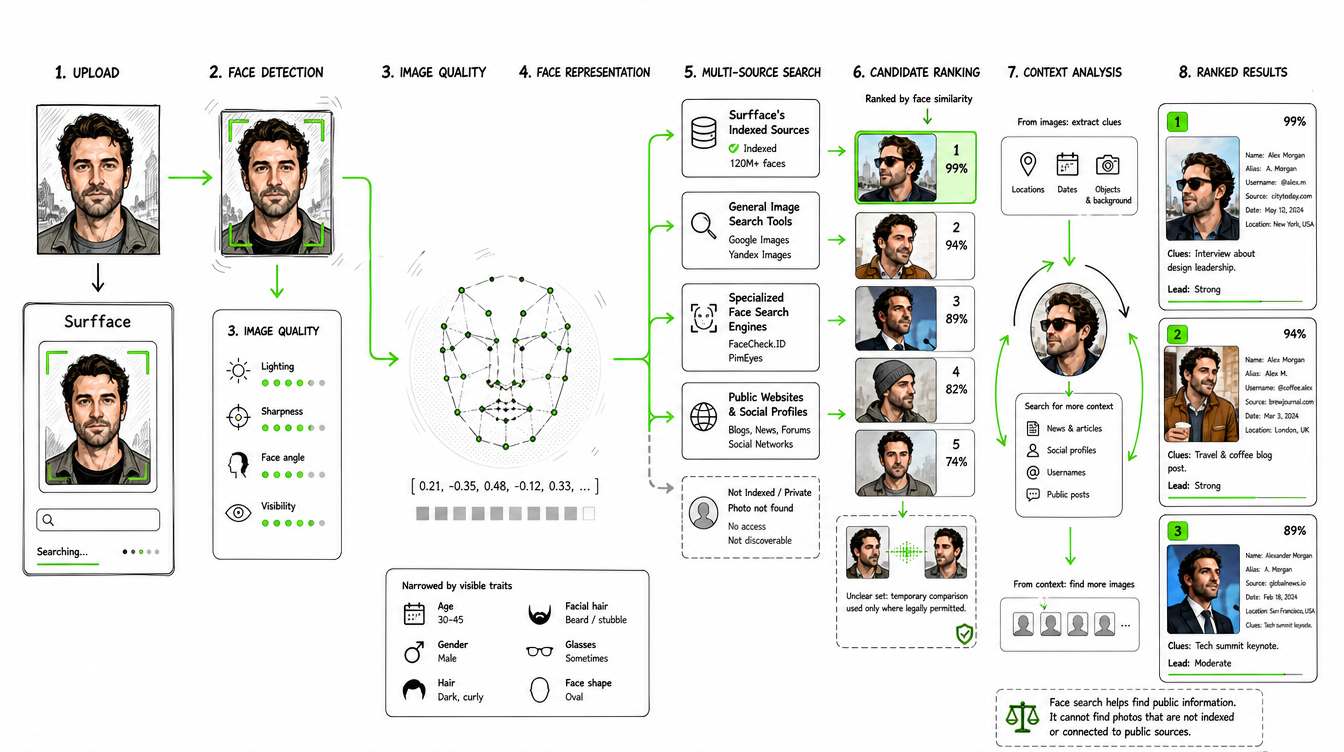
A facial recognition internet search involves more than comparing two faces.
The system must detect the main face, assess image quality, create a searchable representation, compare it with indexed faces and rank possible candidates. It must then connect those candidates with public source pages, names, dates, usernames and other context.
Index coverage is critical.
Even the most accurate facial recognition model cannot find a photo that is absent from its database or unavailable through connected search tools. This is why a useful online facial recognition service needs both strong matching technology and broad source coverage.
How Surfface searches from a photo
Surfface does not rely on a single facial recognition database or matching method. It searches its own index and external tools such as Google Images, Yandex Images and specialized face search engines for exact copies, edited photos and visually similar faces.
It also analyzes public context linked to each image, including names, aliases, usernames, social profiles, captions, news, dates and locations. Image matches can trigger new context searches while contextual clues can lead to additional face searches. This helps uncover connections that a basic one-step facial recognition search may miss.
Surfface first ranks candidates using visible traits such as approximate age, gender presentation, hair color, glasses, facial hair and face shape, then considers names, captions, dates, locations and account context. When a small candidate set remains unclear, it may use facial recognition where legally permitted. Any face embeddings created for the comparison are temporary and discarded afterward, so Surfface does not depend on a permanent biometric database. Learn more about Surfface search process.
Facial recognition versus reverse image search
Facial recognition search and reverse image search solve different problems.
Reverse image search analyzes the whole picture. It is best for finding exact copies, edited versions, crops and pages using the same image.
Facial recognition focuses on the person’s face. It may find the same person in a different photo with another background, hairstyle, expression or camera angle.
For example, reverse image search may locate the exact profile picture on another website. Facial recognition search may find a separate photo of the same person connected to another public profile.
The strongest workflow uses both approaches. Surfface combines its own face and image index with traditional image engines and specialized face searches.
Benefits of facial recognition
Faster everyday access
Face ID shows the most familiar benefit of facial recognition. It replaces a manual password step with a quick visual identity check.
The same principle can make account access, device security and identity verification more convenient.
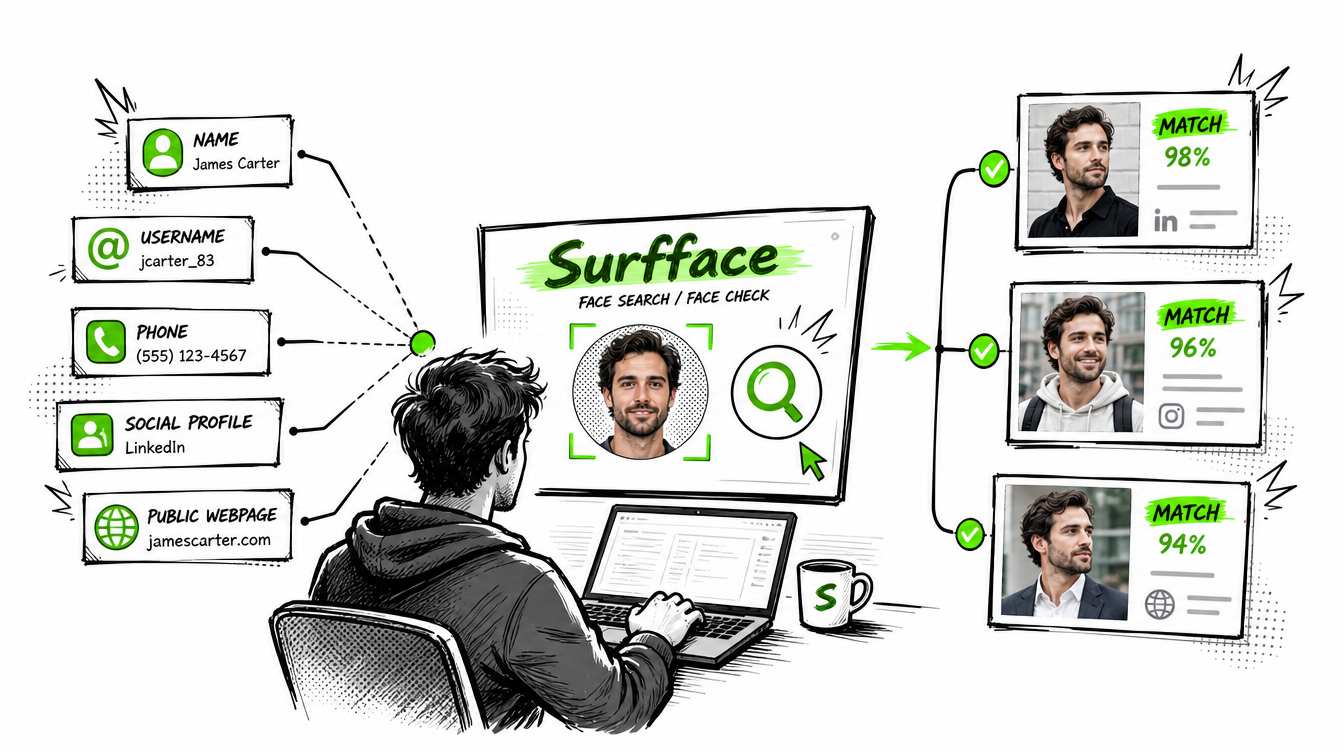
Search when all you have is a photo
Names may be unknown, misspelled or deliberately false. Usernames and phone numbers can be changed quickly.
A face photo can provide a useful starting point when no reliable text identifier is available.
Find different photos of the same person
Reverse image search may find copies of one picture. Facial recognition may find the person in completely different images.
This is useful when a person has changed their hairstyle, background, expression or profile photo.
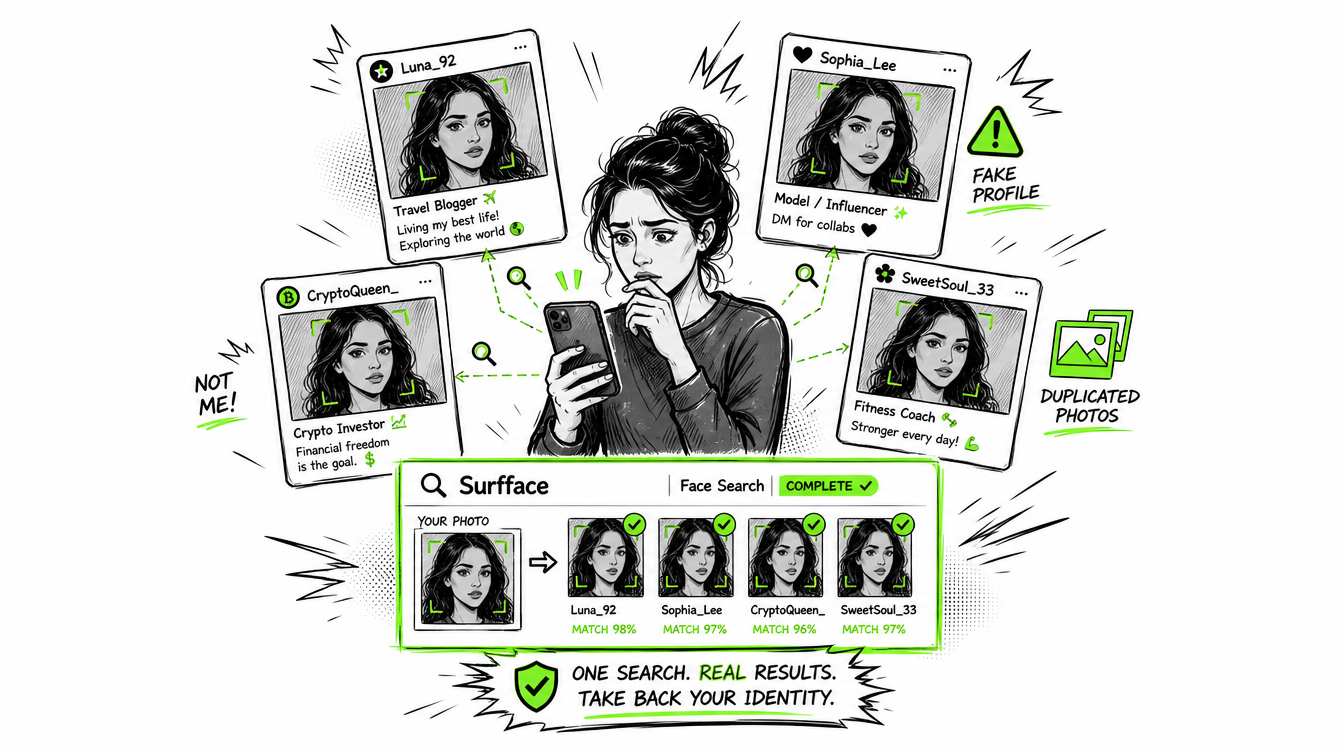
Detect photo misuse and impersonation
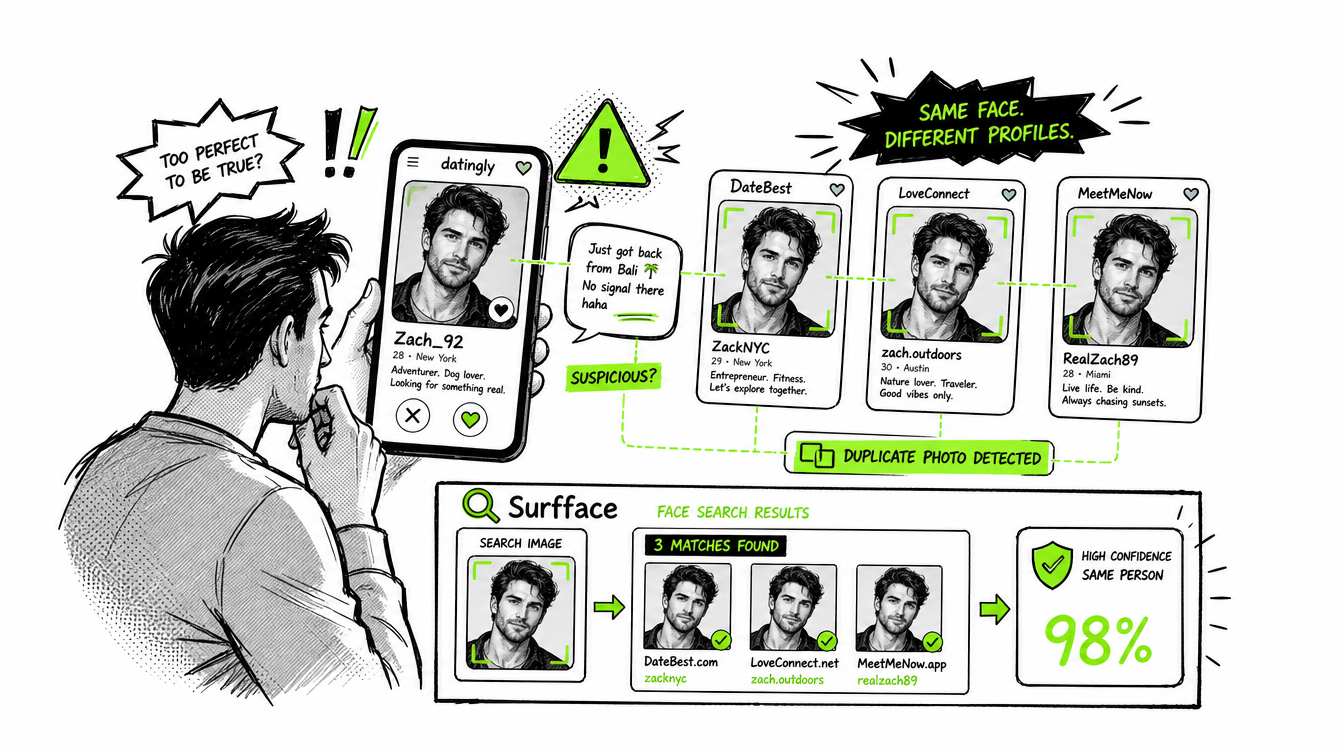
Online facial recognition can help determine whether the same face appears on unfamiliar accounts or under conflicting names.
It can be useful when checking whether your own photos are being reused or whether a suspicious profile may be using someone else’s identity.
A match is a lead rather than proof. Always review the original source and surrounding information.
Search public safety sources
Where available, Surfface can search public U.S. sources that include mugshots, criminal-record photos and registered sex offender information.
These results require careful review. Surfface is not an official background check provider and a visual similarity does not prove that the person in the uploaded photo is the individual named in a record.
Reduce manual research
Searching separately through image engines, social platforms, news and public records takes time.
A facial recognition search can narrow a large number of possible pages into a smaller group of candidates for manual verification.
Improve fraud prevention
Face verification can help compare a live user with an enrolled image or identity document.
Advanced systems may also use liveness checks to detect printed photos, screen replays, masks or manipulated video.
Organize large image collections
Face embeddings can group photos that likely show the same person.
This is useful for photo libraries, media archives and investigations involving large numbers of images.
Age, gender and visible-trait detection
Not every facial analysis task is designed to identify a person.
Some models estimate approximate age, gender presentation and visible characteristics such as glasses, facial hair, hair color or face shape.
These signals can help filter and rank candidates. For example, a search system may prioritize photos with a similar age range and visible traits.
However, these outputs are estimates. Age can be affected by lighting, makeup, image quality and facial expression. Gender presentation cannot reliably establish a person’s gender identity.
Attribute detection should support a search rather than serve as final proof.
Main facial recognition challenges
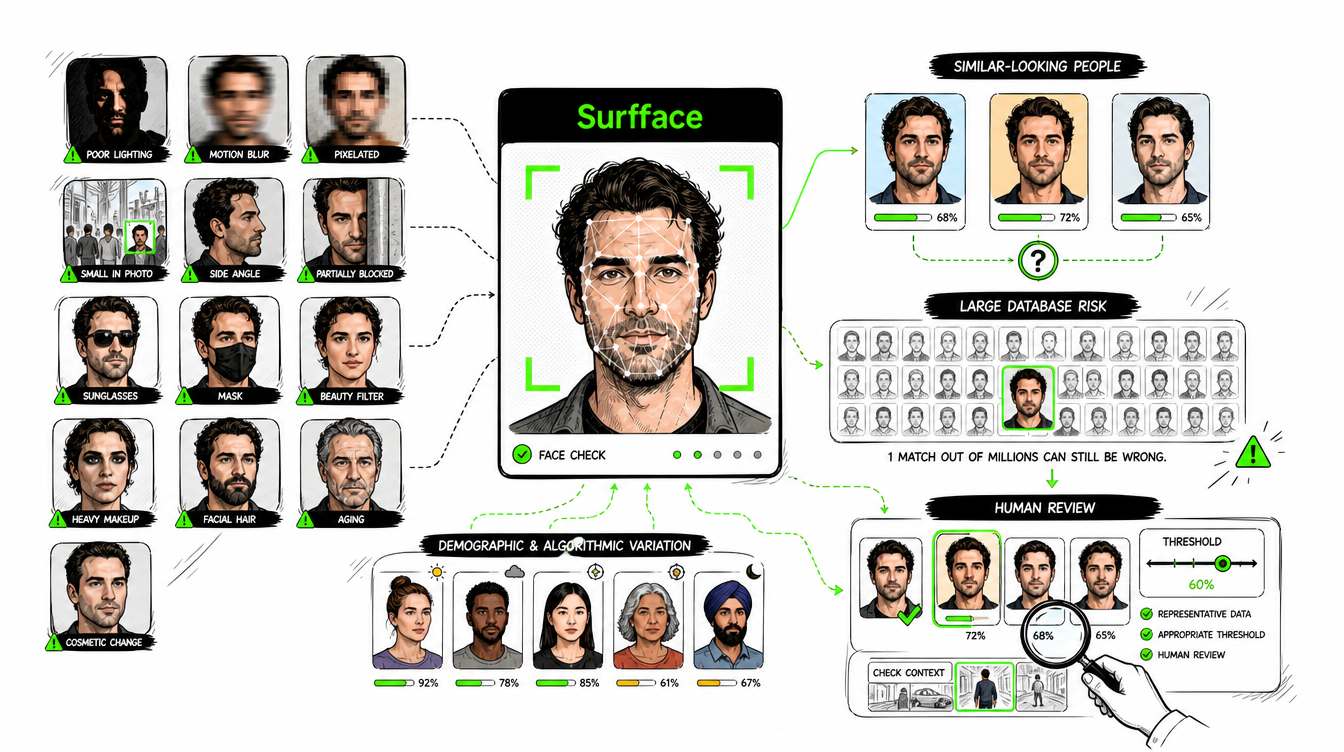
- Facial recognition becomes less reliable when a photo has poor lighting, blur, heavy compression, a very small face, an extreme side angle or major obstructions.
- Sunglasses, masks, filters, makeup, facial hair, aging and cosmetic procedures can also affect performance.
- Similar-looking people create another challenge. A result may appear convincing without showing the same person.
- Large databases increase this risk because even a low false-match rate can produce misleading candidates when millions of faces are compared.
- Accuracy can also vary between demographic groups, algorithms and image conditions. Reliable systems need representative training data, appropriate thresholds and human review.
Recent advances in facial recognition
Modern facial recognition is improving in several areas.
- Better face embeddings create stronger separation between different identities.
- Transformer architectures analyze relationships across the full face.
- Hybrid models combine local CNN features with global transformer attention.
- Image quality assessment predicts whether a photo is suitable for reliable comparison.
- Liveness detection identifies printed photos, video replays and other spoofing attempts.
- Attribute analysis improves estimates of age, gender presentation and visible facial traits.
- Multimodal search combines face similarity with names, captions, usernames, dates and locations.
- Federated search connects several databases and external search tools through one workflow.
For online face search, the largest improvement is not one AI model. It is the ability to combine facial similarity, image matching and public-source context.
How to get better facial recognition search results
Use a clear photo where the face is large enough to see, both eyes are visible and the lighting is reasonably even.
Avoid heavy filters, strong blur, text over the face and extreme side angles.
Try more than one photo when possible. A front-facing image, casual photo and older image may produce different results.
Review the source page rather than judging only the thumbnail. Compare names, dates, locations, usernames and surrounding content.
Do not assume the first or highest-scoring candidate is correct.
Can you run a facial recognition search free?
A facial recognition search free of charge usually provides match previews, limited searches or partial source information.
Surfface lets users start with a free search to see whether potentially useful matches exist. Users can review candidate images and similarity signals before deciding whether to unlock more source information or run a deeper search.
Free results are useful for judging whether a photo produces promising leads. They do not guarantee complete internet coverage.
What facial recognition cannot do
Facial recognition cannot guarantee a person’s identity from one photo.
It cannot search private accounts, access private messages or find images that were never publicly available or indexed.
It also cannot replace official identity verification, law enforcement records or a regulated background check.
No results does not mean that a person has no online presence. Their images may be private, blocked, unindexed or too different from the uploaded photo.
Surfface is a public-data search tool. Results are investigative leads that may be incomplete and must be verified independently.
Start an online facial recognition search
When a photo is your only reliable clue, Surfface is usually the easiest place to start.
It combines its own face and image index with Google Images, Yandex Images, specialized face searches and public-data research. It also uses visible facial characteristics and contextual signals to rank the most relevant candidates.
Upload a clear face photo, review possible matches then verify each result through its original public source.

Stanley Wiggins
Stan leads product marketing at Surfface, bringing a mix of experience in OSINT and private investigations, along with expertise in digital marketing and product management.