OSINT Explained: Meaning, Techniques, Tools and Real Investigations
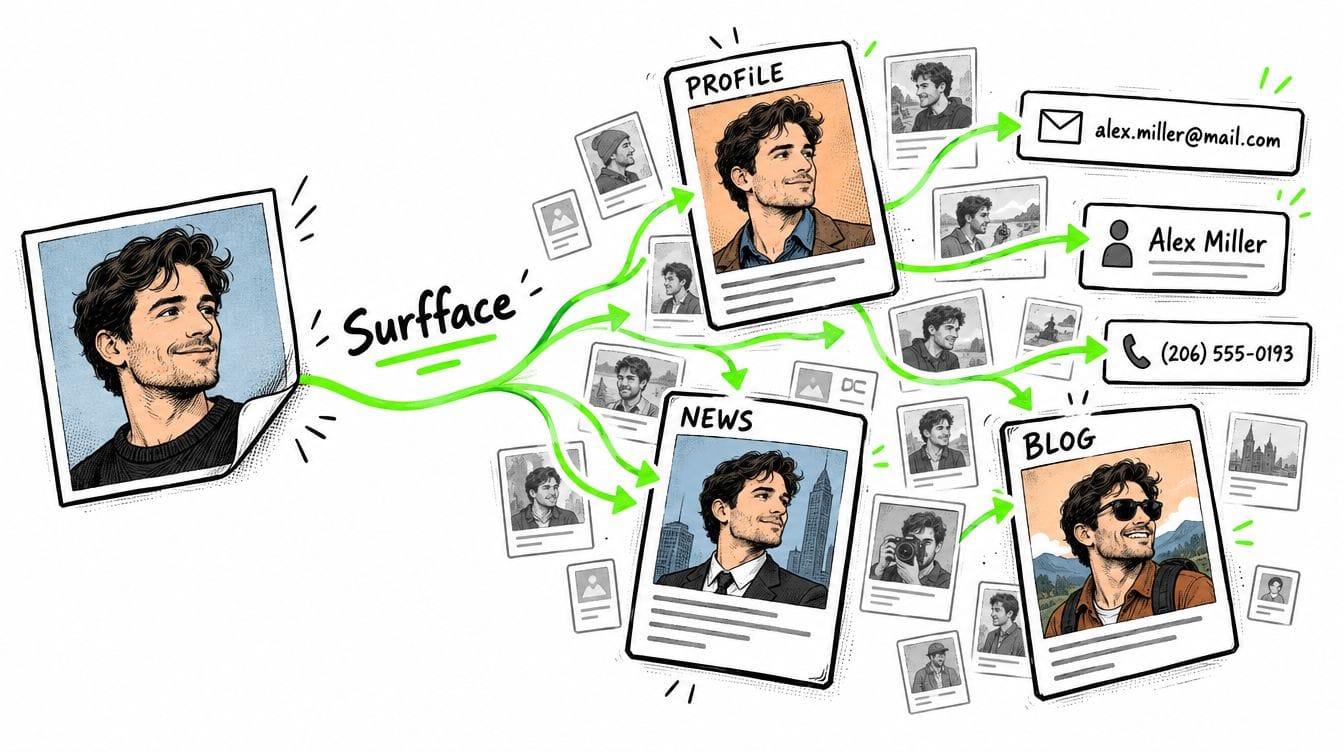
OSINT is the collection and analysis of publicly available information to answer a specific question. Investigators use search engines, social media, public records, maps, images, metadata and cybersecurity data to verify people, events and digital infrastructure. When the only available clue is a face photo, Surfface can provide the fastest practical starting point by searching its own face index and multiple external discovery tools from one place.
What is OSINT?
OSINT stands for open-source intelligence. It is the process of finding, collecting, verifying and analyzing information from publicly accessible sources.
The key word is not simply “open.” The important word is “intelligence.”
Finding a social media profile is information. Connecting that profile to a company, location, phone number and group of related accounts may produce intelligence that answers a real question.
OSINT therefore involves more than searching Google. It requires a defined objective, structured collection, verification and analysis.
OSINT meaning in practical terms
The practical OSINT meaning is simple:
Start with one known clue, find connected public information and verify whether the pieces describe the same person, organization, event or digital asset.
A clue can be almost anything:
- A name
- A face photo
- An email address
- A phone number
- A username
- A company
- A website
- An IP address
- A vehicle
- A building
- A document
- A social media post
An investigator then “pivots” from one clue to another.
For example, a username may lead to a public profile. The profile may contain a photo that appears on another platform. A linked website may reveal a company name. A corporate registry may identify directors. Archived pages may show information that has since been removed.
This movement between connected identifiers is at the center of most OSINT investigations.
OSINT has roots in government and intelligence work but it is now widely used by journalists, cybersecurity analysts, investigators, fraud teams, researchers, companies and ordinary internet users. The commonly accepted definition focuses on publicly available information that is collected and analyzed to answer a specific intelligence requirement.
What OSINT is not
OSINT does not mean hacking into accounts, accessing private messages or bypassing security controls.
It also does not mean that every piece of public information can be used without limits. Privacy laws, platform rules, contractual restrictions and local regulations may still apply.
Publicly visible information can also be wrong. Profiles may be fake. Photos may be stolen. Records may be outdated. Automated systems may connect two unrelated people.
For this reason, OSINT findings should usually be treated as leads until they are confirmed through independent evidence.
Real OSINT investigations
There are many notable OSINT investigations, but this article highlights only two well-known cases with publicly accessible sources.
The investigation of flight MH17
After Malaysia Airlines Flight 17 was shot down over eastern Ukraine in 2014, open-source investigators collected videos, photographs, social media posts, satellite imagery and location evidence connected to a Buk missile launcher.
Bellingcat reconstructed the launcher’s route and associated it with Russia’s 53rd Anti-Aircraft Missile Brigade.
The official Joint Investigation Team later stated that the Buk system used to shoot down MH17 came from that brigade. The investigation also used witness testimony, satellite and radar imagery, intercepted calls, telecom information and other large datasets.
This case demonstrated the power of combining visual evidence, geolocation, chronology and infrastructure analysis.
The Navalny poisoning investigation
Bellingcat and its media partners investigated the poisoning of Russian opposition figure Alexei Navalny by analyzing travel records, phone metadata and other datasets.
The investigation connected a group of suspected Russian security officers to Navalny’s movements before the poisoning. One reason the work attracted attention was its transparency. Readers could review how the separate records were connected rather than being asked to trust an unnamed intelligence source.
How OSINT investigations work
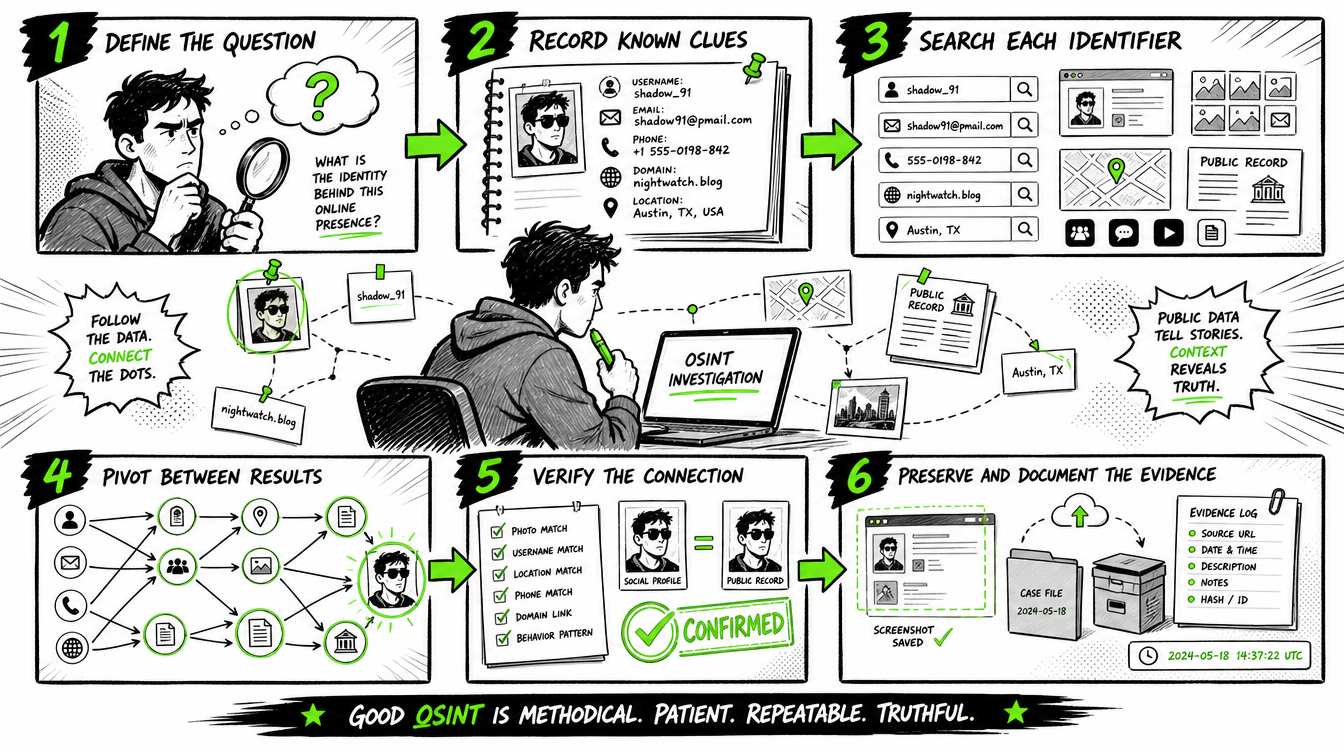
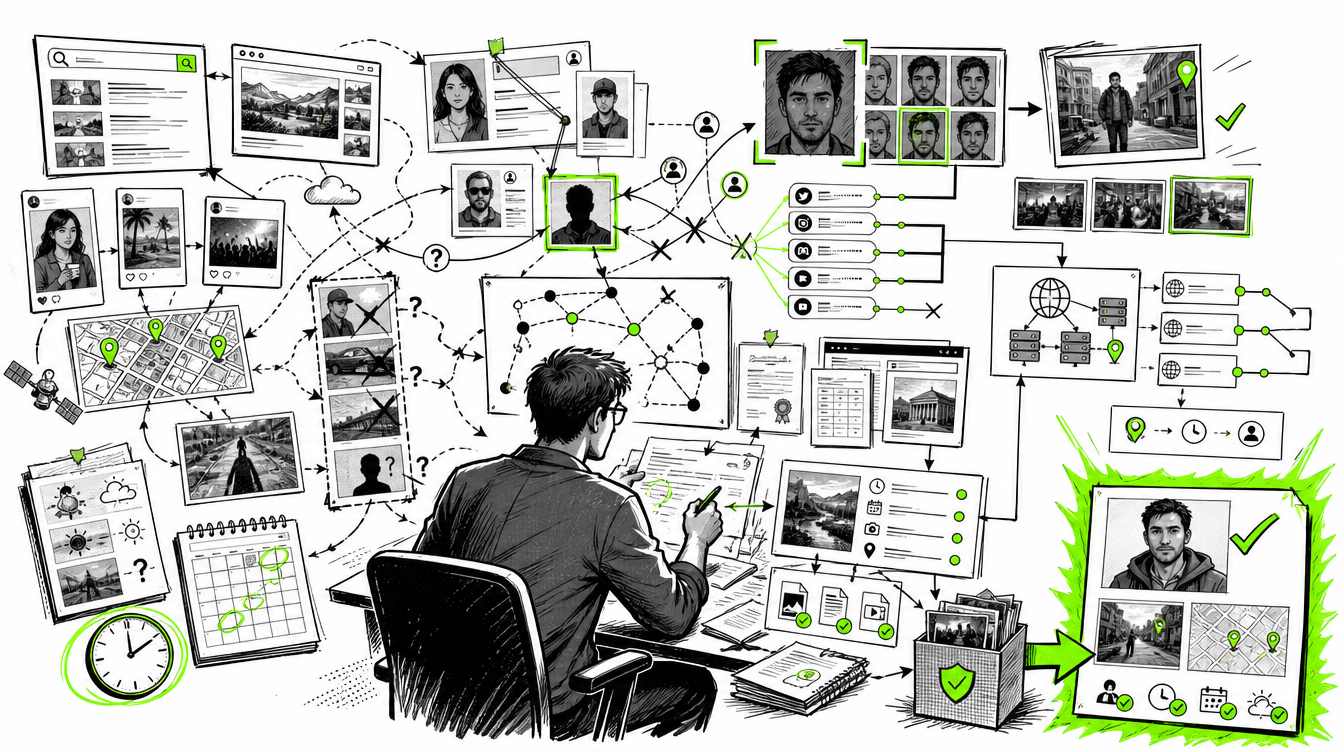
A professional OSINT investigation usually follows six stages.
1. Define the question
Do not begin by collecting everything you can find.
Start with a narrow question such as:
- Is this social profile connected to a real person?
- Where else does this face appear online?
- Are these two accounts operated by the same person?
- Who owns this website?
- Where was this video recorded?
- Is this company connected to another organization?
- Has this image appeared before the event it supposedly shows?
A clear question prevents the investigation from becoming an unstructured search through irrelevant data.
2. Record the known identifiers
List every confirmed clue before searching:
- Exact and alternative names
- Usernames
- Profile URLs
- Face photos
- Emails
- Phone numbers
- Domains
- Locations
- Dates
- Organizations
- Image filenames
- Vehicle numbers
- Cryptocurrency addresses
Separate confirmed facts from assumptions. This helps prevent an early theory from shaping every later conclusion.
3. Search each identifier
Search identifiers individually and in combinations.
A name alone may produce thousands of results. A name combined with an employer, city, username or image can reduce the search space.
Investigators also search variations such as:
- Old usernames
- Transliteration variants
- Nicknames
- Reversed name order
- Previous company names
- Cropped versions of an image
- Phone numbers in different international formats
4. Pivot between results
Every credible result may create a new search path.
A face match can reveal a username. The username can reveal a public profile. The profile can reveal a workplace. The workplace may lead to a corporate record or archived employee page.
This process creates an evidence network rather than one isolated search result.
5. Verify the connection
A match is not automatically proof.
Check whether several independent details agree:
- Facial features
- Location
- Age range
- Employment history
- Associated usernames
- Dates
- Friends or relatives
- Website ownership
- Repeated contact details
- Original publication source
Strong OSINT conclusions usually rely on multiple signals rather than a single database entry.
6. Preserve and document the evidence
Online information can change or disappear.
Record the source URL, access date, screenshots, archived copies and the steps used to find the information. For investigations that may support legal or human rights work, evidence preservation and documentation are especially important.
The Berkeley Protocol on Digital and Open Source Investigations was developed to provide standards for identifying, collecting, preserving, verifying and analyzing digital open-source information that may be used in investigations.
Starting photo-based OSINT with Surfface
Surfface is designed for OSINT investigations that begin with a face photo.
It searches for possible appearances of the face across public online sources such as websites, news pages, blogs, public social profiles and U.S. public-record sources where available.
Surfface differs from a standalone face search engine because it combines several discovery layers:
- Its own face search index
- Specialized U.S. public-record pipelines
- Google Images
- Yandex Images
- Other external image and face search services
This makes Surfface a practical first step when the investigator does not yet have a reliable name, username, email address or phone number.
Compared with tools such as PimEyes and FaceCheck ID, Surfface is especially focused on U.S. investigations. Its dedicated public-record coverage can include mugshot and registered sex offender sources where legally and publicly available.
A Surfface result is an investigative lead, not an official identity determination or criminal background check. Sources may be incomplete, outdated or connected to a different person with a similar appearance. Every important result should be reviewed manually.
Main OSINT techniques
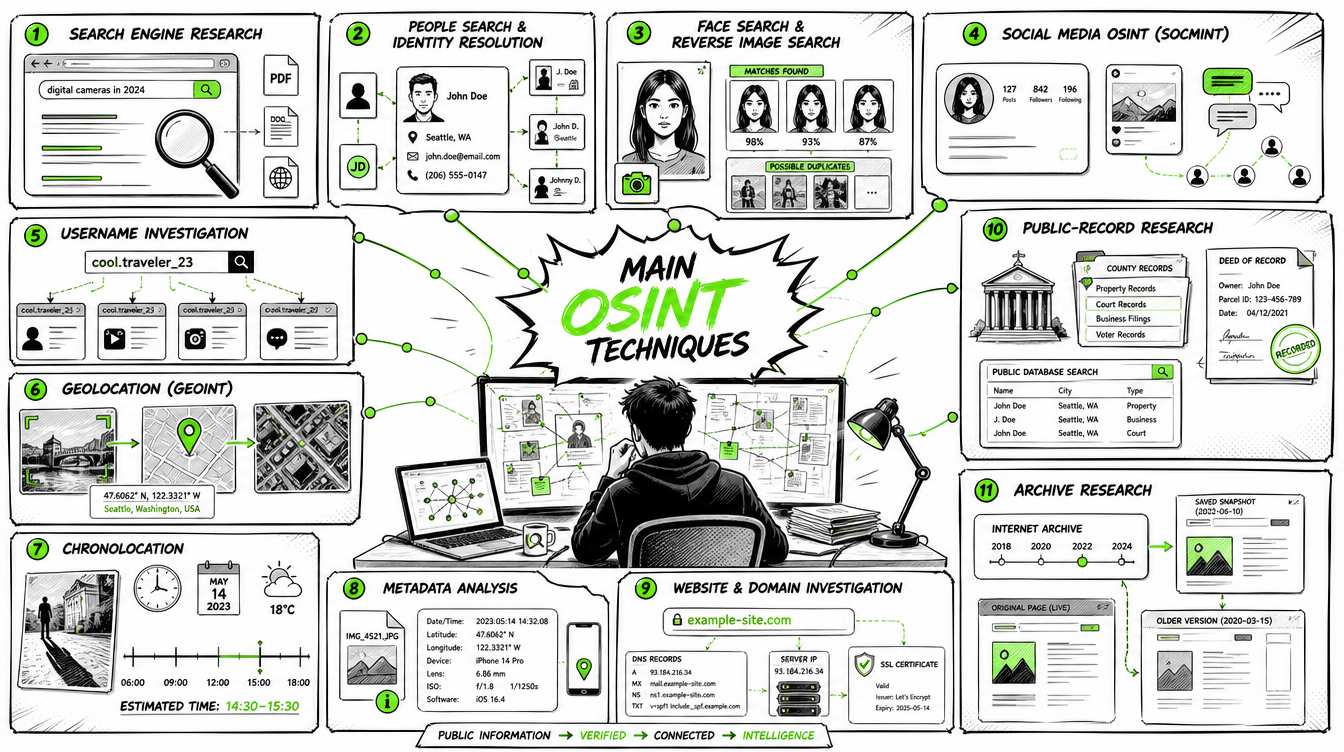
OSINT techniques vary by investigation but most fall into several practical categories. No tool is comprehensive. Successful OSINT investigations usually combine several tools and verify important findings manually.
Search engine research
Search engines remain one of the most useful OSINT tools.
Advanced operators can narrow results by domain, file type, title, exact phrase or date. They may uncover public documents, old employee pages, exposed directories and references that are difficult to find through a normal search.
Useful approaches include:
- Searching exact phrases in quotation marks
- Restricting results to a specific website
- Searching PDF, spreadsheet or presentation files
- Excluding irrelevant words
- Combining names with locations or employers
- Searching alternative spellings and languages
Different search engines maintain different indexes. A page or image missing from Google may still appear in Bing or Yandex.
People search and identity resolution
People-focused OSINT starts with personal identifiers such as a name, email, phone number, username or face.
The investigator searches for public accounts and then checks whether the details belong to the same person.
Useful signals include:
- Repeated profile photos
- Identical usernames
- Connected email addresses
- Shared biographies
- Matching cities
- Employment references
- Public relatives or associates
- Consistent posting history
The objective is not to collect the largest possible amount of personal data. It is to determine whether separate public references can be reliably connected.
Face search and reverse image search
Reverse image search looks for exact or visually similar versions of an entire image. It is effective for detecting copied photos, altered images, product pictures and original publication pages.
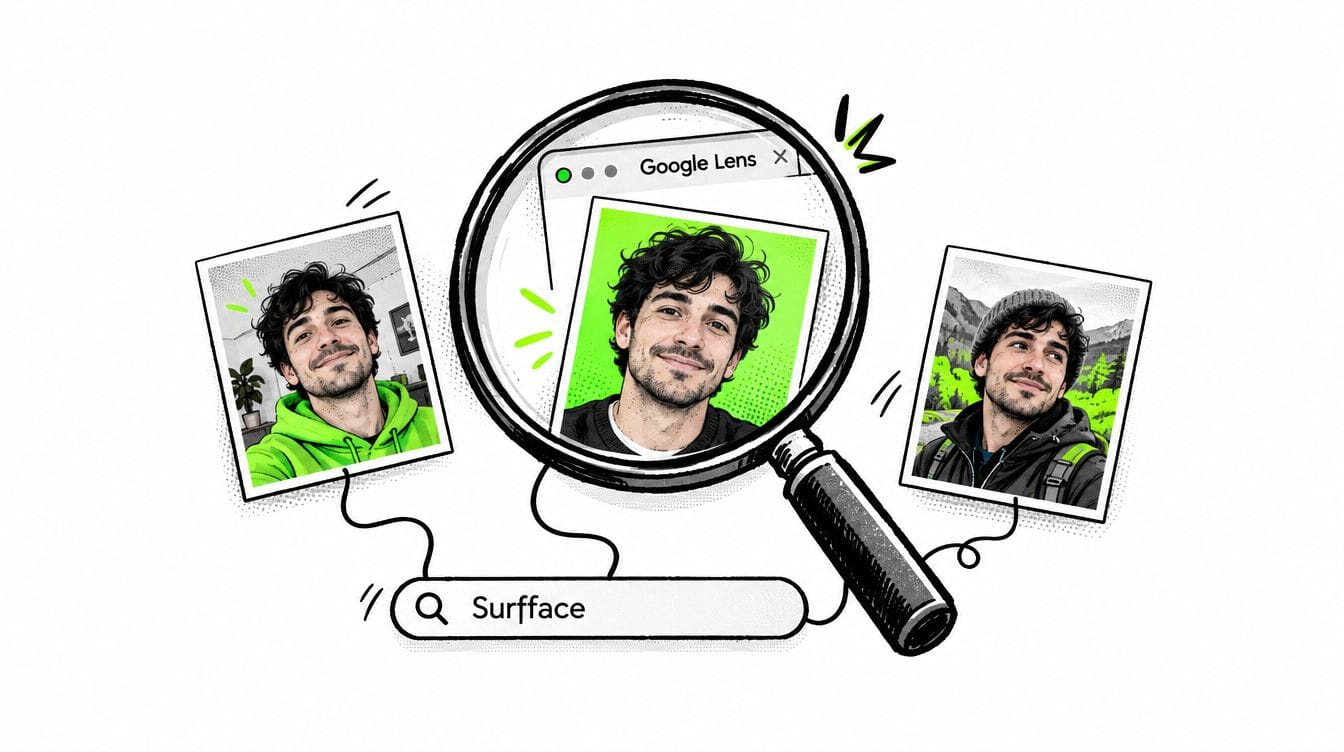
Face search focuses on the person inside the photo. It may find the same face across different backgrounds, crops, poses, hairstyles or image quality levels.
This distinction is important. A conventional reverse image engine may miss a different photo of the same person because the complete image looks different.
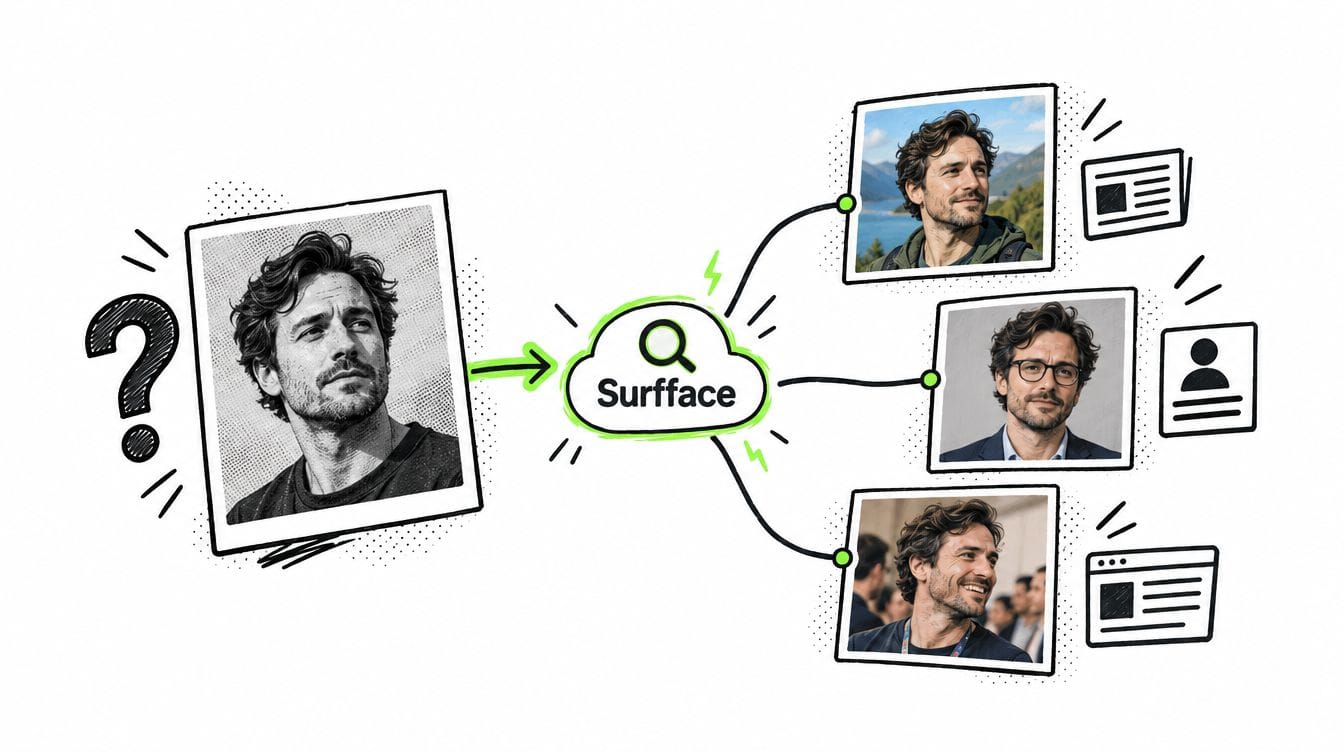
Face search becomes particularly valuable when a photo is the only clue. A face cannot be entered into a standard name, email or phone search field. In this situation, face search may be the only practical way to create the first useful lead.
Social media OSINT (SOCMINT)
Social media can reveal identities, relationships, interests, locations and historical activity.
Investigators may examine:
- Public profile information
- Old usernames
- Profile and cover photos
- Tagged public posts
- Repeated phrases
- Posting times
- Follower relationships
- Public comments
- Location references
- Links to external websites
A single post rarely proves an identity or event. The value appears when multiple public signals form a consistent pattern.
Investigators should also distinguish between information published by the subject and information posted by other people. A photo depicting someone does not necessarily come from that person’s own account.
Username investigation
Many people reuse usernames across platforms.
Tools such as WhatsMyName, Sherlock and Maigret can check whether a username exists across a large number of services. These results still require manual review because the same username may be used by unrelated people.
A good username match should be supported by other common details such as a face, biography, location, writing style or linked account.
Geolocation (GEOINT)
Geolocation is the process of determining where an image or video was created.
Investigators compare visual details such as:
- Road markings
- Street signs
- Architecture
- Mountains
- Vegetation
- Utility poles
- Business names
- Vehicle plates
- Shadows
- Weather
- Public transportation
- Building layouts
These details can then be compared with maps, street-level imagery, satellite images and local photographs.
Geolocation is one of the techniques that made large-scale public investigations possible. Bellingcat publishes guides covering satellite imagery, social media research, flight tracking, geolocation and evidence preservation.
Chronolocation
Chronolocation attempts to determine when a photo or video was recorded.
Investigators may use:
- Publication timestamps
- Weather records
- Sun and shadow positions
- Construction progress
- Seasonal vegetation
- Visible events
- Satellite imagery
- Archived versions of websites
- Earlier copies of the same image
Metadata can help but it should not be trusted alone because timestamps can be modified or removed.
Metadata analysis
Files can contain information that is not immediately visible.
Metadata may include:
- Creation dates
- Editing software
- Device models
- Author names
- GPS coordinates
- Document revision history
- Internal filenames
- Organization names
ExifTool is widely used to inspect metadata in images, videos and documents. Metadata should be treated as one signal because files can be edited, compressed or deliberately manipulated.
Website and domain investigation
Domains and websites can reveal connections between organizations, infrastructure and individuals.
Common OSINT techniques include examining:
- Domain registration records
- DNS records
- IP addresses
- Hosting providers
- TLS certificates
- Subdomains
- Historical DNS data
- Archived pages
- Website analytics identifiers
- Source code
- Reused contact details
Tools such as SecurityTrails, DomainTools, urlscan.io, Shodan and Censys help investigators examine internet infrastructure. Access levels and historical coverage vary by platform.
Public-record research
Public records can include:
- Corporate registrations
- Court documents
- Property records
- Professional licenses
- Political contributions
- Government contracts
- Sanctions lists
- Police publications
- Registered offender databases
- Regulatory actions
Availability differs significantly by country, state and county.
Public records should not automatically be interpreted as complete or current. A record may describe an allegation rather than a conviction. Another person may share the same name. Some records may have been expunged, corrected or published without later case outcomes.
Archive research
Websites, posts and documents can disappear.
The Internet Archive’s Wayback Machine, archive.today and specialized archiving tools may preserve earlier versions of pages.
Archives can help investigators find:
- Deleted biographies
- Previous company claims
- Old contact information
- Changed product descriptions
- Earlier ownership information
- Removed articles
- Historical website links
An archive proves that a page appeared in a particular captured form. It does not prove that every statement on the page was true.
Public, commercial and restricted OSINT tools
OSINT resources can be separated into three broad levels.
Public tools
These are available to ordinary users and often provide free access.
Examples include search engines, web archives, public registries, maps, metadata tools and username checkers.
Commercial intelligence tools
These platforms may combine public information with licensed datasets, automation, monitoring and collaboration features.
They are commonly used by cybersecurity teams, fraud departments, compliance professionals, investigators and journalists.
Examples include Maltego, commercial threat-intelligence platforms, specialized people-search services and historical domain databases.
Restricted government and law-enforcement systems
Government agencies and law-enforcement organizations also use restricted investigation, intelligence and case-management platforms.
Some systems analyze open sources while also connecting them to non-public government records. Once private, classified or legally restricted data is introduced, the complete system is no longer pure OSINT even when some of its inputs come from public sources.
Public descriptions of restricted platforms are often incomplete. Claims about secret intelligence tools should therefore be treated with caution. A credible OSINT report should not speculate about capabilities that cannot be independently verified.
Common OSINT mistakes
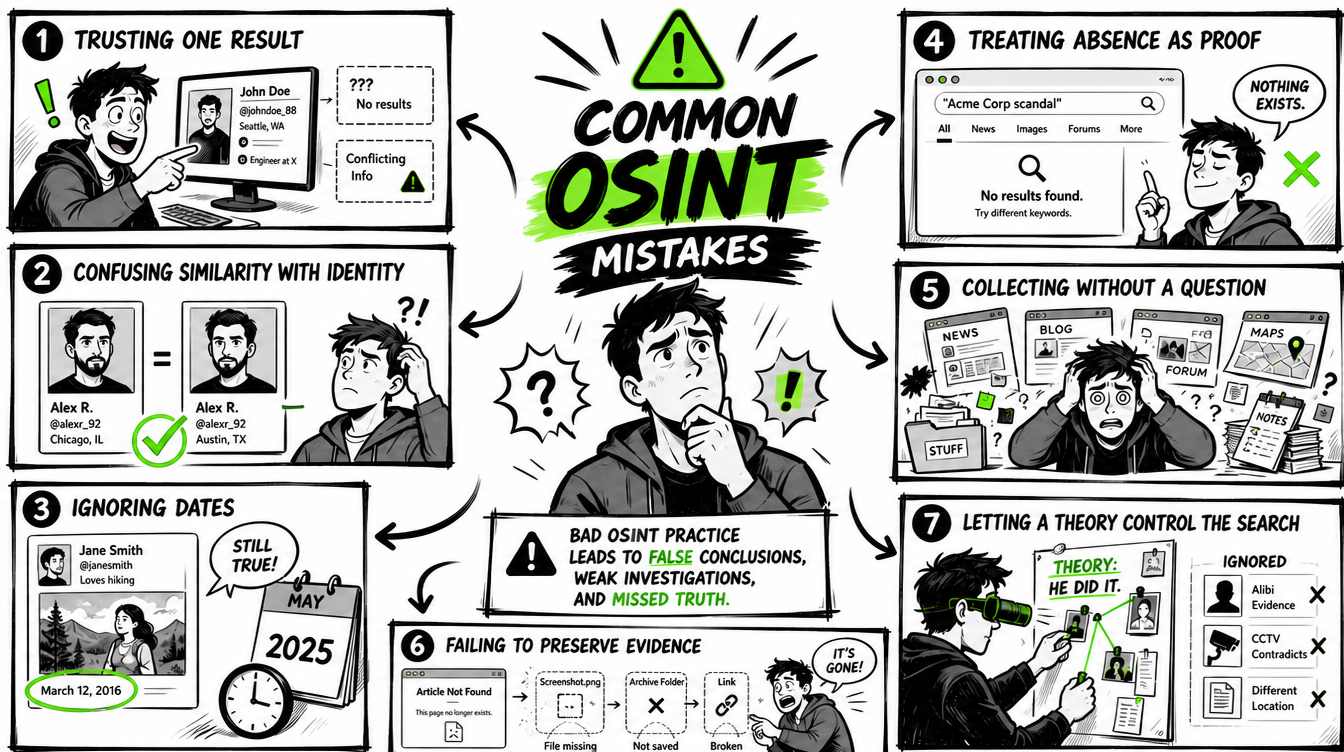
- Trusting one result
One matching name, username or face is rarely enough. Look for independent confirmation. - Confusing similarity with identity
Two photos can look similar without showing the same person. Face search results require manual review. - Ignoring dates
An old address, employer or photograph may no longer describe the current situation. - Treating absence as proof
Finding no matches does not prove that a person, account or event does not exist. The source may be private, deleted, unindexed or published under another identifier. - Collecting without a question
Large amounts of data create noise. Define the investigation objective first. - Failing to preserve evidence
A result that cannot be reproduced or documented may have little investigative value. - Letting a theory control the search
Confirmation bias causes investigators to notice evidence supporting their assumption while dismissing contradictory details. Record alternative explanations and search for evidence that could disprove the initial theory.
Is OSINT legal?
OSINT generally involves lawfully accessible information but its use is still affected by jurisdiction, purpose and method.
Important considerations include:
- Privacy and data-protection laws
- Platform terms of service
- Copyright
- Anti-harassment and stalking laws
- Computer access laws
- Employment and tenant-screening regulations
- Rules governing criminal records
- Restrictions on biometric processing
- Policies covering minors and sensitive content
Do not use OSINT to threaten, harass, expose private addresses or target vulnerable people.
Businesses should also avoid using general people-search or face-search results as substitutes for regulated employment, credit, housing or criminal background checks.
Final thoughts
OSINT turns scattered public information into evidence that can answer a defined question.
The best OSINT investigations do not depend on one powerful tool. They combine search engines, archives, public records, maps, social media, metadata, cybersecurity data and careful human verification.
The starting point depends on the clue you have.
A name can begin a people search. A domain can begin an infrastructure investigation. A username can reveal a network of accounts. A street sign can reveal a location.
When all you have is a face photo, begin with face search. Surfface can search its own index, specialized U.S. public-record sources and several external discovery engines from one place. A credible match can reveal the first name, profile, website or location needed to continue a broader OSINT investigation.
Search first. Verify every connection. Treat results as leads until independent evidence confirms them.

Stan leads product marketing at Surfface, bringing a mix of experience in OSINT and private investigations, along with expertise in digital marketing and product management.