Copyright Violation: Find and Report Stolen Photos
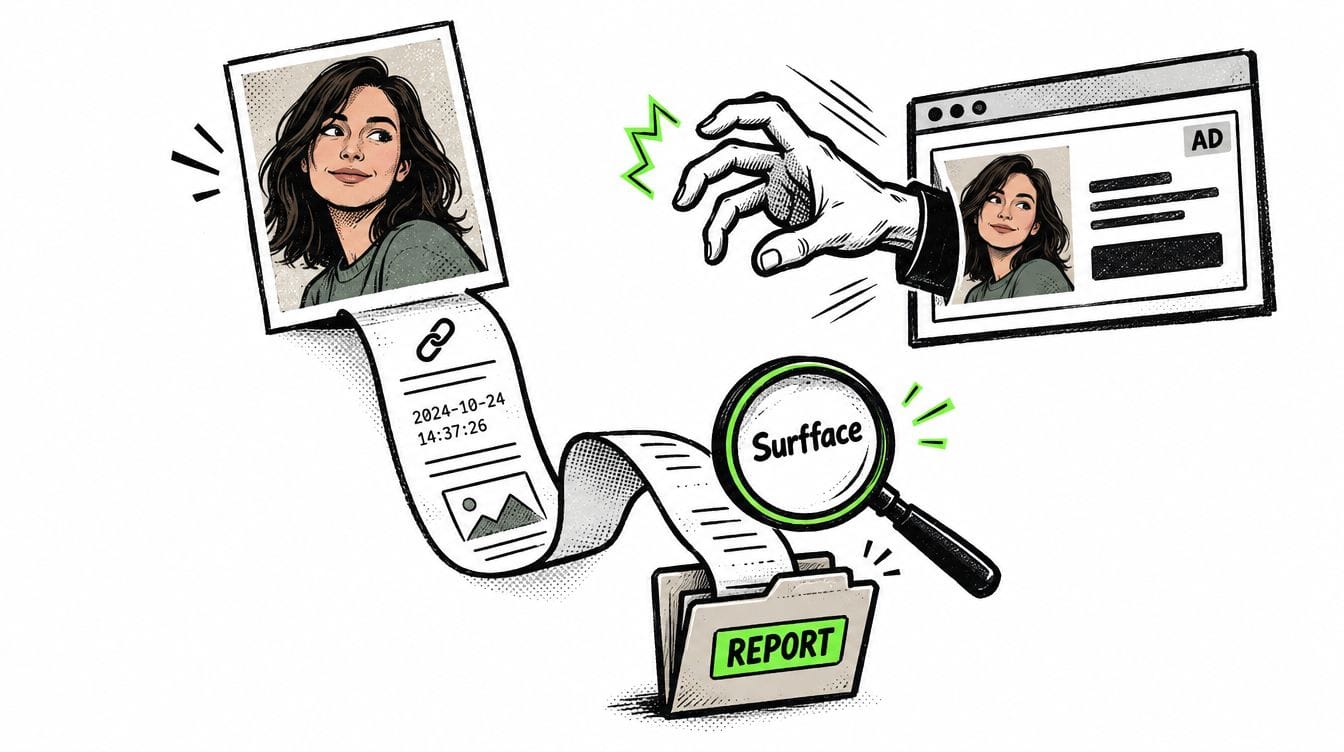
A copyright violation occurs when someone uses a protected work in a way reserved to its owner without permission or a legal exception. For photos, start by finding the reuse, saving evidence and checking who owns the rights. Then choose a removal request, copyright report or legal response. Surfface can help uncover public pages featuring a face but a match alone does not prove infringement.
This guide focuses on U.S. copyright rules. Other countries may use different procedures.
What counts as a photo copyright violation?
An unlicensed copy of your portrait in a product ad, a repost of your photograph on a commercial website or use beyond an agreed license can be a photo copyright violation. The details matter: there may be permission, an applicable exception or an expired copyright.
Imagine you take a headshot for a client’s company website. Months later, the same image appears in an unrelated supplement ad. You need to establish that the ad copied your photograph and that its use was not authorized.
Finding another photograph of the same person is different. Copyright protects the photograph’s creative expression, not ownership of the person’s face.
Photo copyright: who owns the image?
The photographer generally owns the copyright initially. Exceptions include qualifying works made for hire. Rights can also be transferred.
Being pictured does not automatically make you the copyright owner. Paying for a portrait does not necessarily transfer copyright either. Check the agreement: you may have permission to use the image while the photographer retains ownership.
Original photographs receive protection when they are taken. A watermark, copyright symbol or registration is not required for protection to exist. Posting a photo publicly does not make it public domain. The U.S. Copyright Office’s guide for photographers explains these basics.
Before reporting, locate your original files, employment terms, assignments and licensing records. If someone else took the picture, ask who holds the rights.
How to find unauthorized uses of your photos
1. Start with Surfface when the photo contains a face
If a portrait is your only clue, start with Surfface face search. You do not need the account name or website address to begin.
Surfface works as a face search orchestrator, bringing its own index and third-party search tools together. It can surface possible matches across public social profiles, news, blogs and available U.S. public records. For copyright checks, concentrate on pages that actually reuse your photograph.
Use this workflow:
- Upload a clear adult portrait you are authorized to search.
- Review possible matches for copies or altered versions of your image.
- If promising matches appear, unlock the search with paid credits to access source links.
- Visit the original pages and check the image in context.
A similar face can lead to useful pages but it cannot establish copying. Compare the pose, clothing, lighting and background to determine whether the result uses the same photograph.
Coverage is incomplete. Private accounts, unindexed pages and restricted sources may be absent. A search with no matches does not prove your photo is unused.
2. Add reverse image and text searches
Use general reverse image tools such as Google Lens or TinEye to look for the same image and modified copies. Try the full photograph first then a crop of its distinctive content.
For landscapes, artwork and product images without faces, general reverse image search is a better starting point.
Also search your name, image title, credit line and distinctive captions. Check suspicious platforms directly. Different methods can reveal different copies.
3. Record each use separately
Create a simple log:
Save evidence before contacting the uploader. A page may disappear or change. Keep your originals untouched and work from copies.
Check permission and fair use before reporting
An unexpected appearance is a reason to investigate. Check whether a client, agency or other authorized licensee permitted the use. For stock images, review the license’s commercial, editorial and distribution limits.
Credit alone does not replace permission. Neither does finding an image through Google.
However, some uses can be lawful without permission. U.S. fair use considers:
- The purpose and character of the use.
- The nature of the copyrighted work.
- How much was used and its significance.
- The effect on the work’s potential market.
News reporting, criticism and education may support fair use but none automatically qualifies. Cropping, adding text or using a small image does not automatically settle the issue either. Consult the Copyright Office’s fair use guidance before making a claim.
For a disputed or commercially significant use, a copyright attorney can assess the specific facts.
How to report a copyright violation
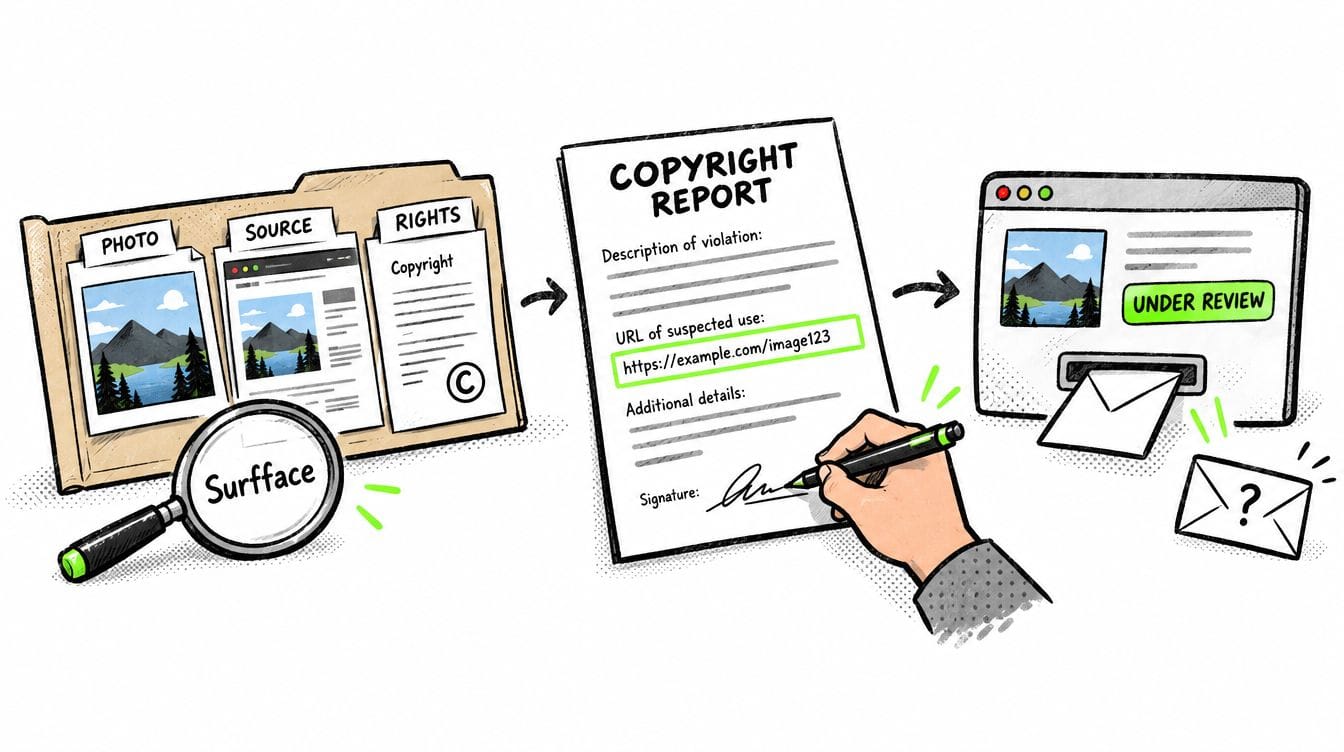
Choose the route that fits your rights and goal.
For identity misuse, see our guide to checking online impersonation.
Send a removal request or DMCA notice
A direct request can identify the photograph, list its location and ask for removal. You do not have to contact the uploader first to submit a valid DMCA notice.
For services using the U.S. DMCA process, use their copyright form or designated agent. The Copyright Office’s notice-and-takedown resources explain the procedure and provide a sample notice. Registration is not required to request a takedown.
A notice should include:
- Identification of the copyrighted work.
- Specific locations of the allegedly infringing material.
- Your contact information.
- Your physical or electronic signature.
- A good-faith statement that the use is unauthorized by the owner, an agent or the law.
- A statement that the information is accurate and that you are authorized to act for the owner, under penalty of perjury.
Use the platform’s form carefully. Knowingly making a material misrepresentation about infringement can expose you to liability. Check which contact details may be shared with the uploader.
Cease and desist copyright violation: when to use a letter
A cease and desist letter for a copyright violation asks the recipient to stop specified conduct. It is a demand, not a court order.
Consider one when you need a formal record, repeated use must stop or the dispute involves a business. Identify the work, explain your rights, list the disputed uses and state the action requested with a reasonable response deadline.
Avoid unsupported accusations and invented penalty amounts. Get legal advice before demanding compensation or threatening litigation.
Follow up after reporting
Keep acknowledgments and check whether each reported copy remains accessible. Removing a search result does not remove the image from its source website.
The uploader may submit a counter-notice. Under the DMCA process, access may be restored 10 to 14 business days after a compliant counter-notice unless the provider receives notice of a qualifying court action. A removal is not a final ruling on infringement.
Trademark vs copyright: which applies?
Trademark vs copyright comes down to what is protected. The USPTO’s comparison distinguishes creative works from signs identifying the source of goods or services.
One incident can raise several issues. A report about a copied photograph is different from a report about brand confusion or impersonation.
How long does copyright last?
In the U.S., works created on or after January 1, 1978 generally receive protection for the author’s life plus 70 years.
Works made for hire and certain anonymous or pseudonymous works generally have a term of 95 years from publication or 120 years from creation, whichever ends first. Older photographs require closer analysis.
A photo’s age, missing credit or unknown creator does not establish that it is public domain. See the Copyright Office’s duration guidance.
Make future misuse easier to detect and document
Keep original files, use clear licenses and retain records of permissions. Consider registration early: for U.S. works, registration is generally required before a federal infringement lawsuit. Its timing can affect access to statutory damages and attorney’s fees.
A visible watermark may discourage casual reuse but it cannot prevent copying. Periodically search your important portraits and record new appearances.
Start with discovery. Then establish the rights and facts before deciding how to respond.
FAQ
A photo copyright violation occurs when someone reproduces, distributes, publicly displays or adapts a protected photograph without authorization or an applicable legal exception. Examples include copying a portrait into an advertisement or using a licensed image beyond the permitted scope. Assess the rights holder, license terms and actual use before concluding that infringement occurred. Public availability does not make a photograph free to use and cropping or editing it does not automatically avoid infringement.
Surfface can help discover public pages featuring your face, including possible copies or altered versions of your portraits. Start with a clear photo then review potential matches. If promising results appear, paid credits unlock source links so you can inspect the original pages and preserve evidence. Compare the complete photograph, including its pose, clothing and background: a different photograph of the same person does not establish copying. Results are investigative leads and incomplete coverage means some uses may remain undiscovered.
No. Copyright generally belongs initially to the photographer, even when you are the subject or paid for the shoot. You may receive a license to use the photograph without acquiring ownership. Exceptions include qualifying works made for hire and valid copyright transfers, which generally require a signed written agreement unless ownership passes by operation of law. A model release concerns permission to use your likeness and does not itself establish copyright ownership. Check the photography contract, license and any assignment before submitting a copyright claim.
No. Attribution identifies the creator but does not authorize reproduction or publication. You still need permission, a license covering the intended use or another legal basis such as fair use. Even an image offered under a Creative Commons license may carry conditions concerning attribution, commercial use or modifications. Check the exact license and whether the person offering it controls the rights. A credit line, source link or “no infringement intended” disclaimer does not substitute for authorization.
No. U.S. DMCA procedures do not require you to send a cease and desist letter before submitting a takedown notice. A copyright owner or authorized agent can report the specific material directly through the service’s copyright form or designated agent. Registration is not required for a takedown request but the notice must satisfy the applicable requirements. A cease and desist letter can document a demand or support negotiations. It is not a court order and neither a letter nor a takedown guarantees compensation.
For most U.S. photographs created on or after January 1, 1978, copyright lasts for the photographer’s life plus 70 years. Works made for hire and qualifying anonymous or pseudonymous works generally receive 95 years from first publication or 120 years from creation, whichever expires first. Older photographs require analysis of their publication history and the rules that applied at the time. Missing credits, an unknown photographer or widespread online circulation do not establish that a photograph is in the public domain.

Stan leads product marketing at Surfface, bringing a mix of experience in OSINT and private investigations, along with expertise in digital marketing and product management.