Identity Verification: Tools, Methods, Face Checks, Costs and OSINT
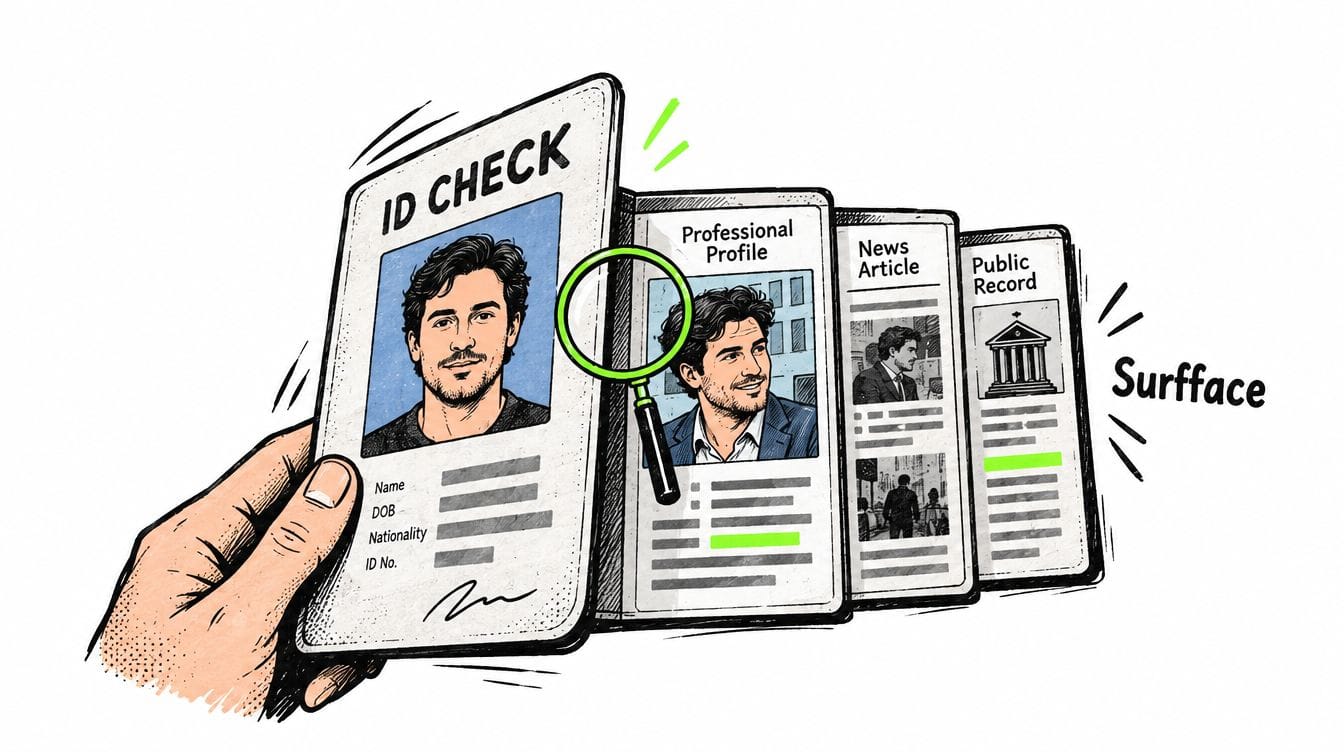
A convincing ID can be fabricated. A real person’s photos can be stolen. Strong identity verification connects the person to independently checked evidence. Providers such as Persona, Stripe Identity, Veriff and Sumsub offer document checks, face verification and other safeguards. OSINT and face search add investigative layers by examining public information beyond what someone submits. If you only have a photo, Surfface offers a practical starting point: discover possible identity connections and inspect the original sources. A match is a lead, not proof of identity or account ownership.
What is identity verification?
Identity verification establishes whether a person is the legitimate owner of the identity they claim. Opening an account might require proving that you are the holder of the passport you submit. Investigating an unfamiliar profile starts with a different question: does its photo and story match credible evidence?
NIST’s identity proofing guidance separates three steps:
- Resolution: Determine which identity the applicant claims and distinguish it from others.
- Validation: Check whether identity evidence and attributes are authentic and valid.
- Verification: Confirm that the applicant is the person the evidence belongs to.
A genuine document and accurate personal details are useful evidence. The process must also connect them to the person presenting them.
How a biometric identity verification system works
Face-based biometric verification commonly compares a captured selfie with an ID portrait. This is a one-to-one comparison: “Does this person match this reference?” Face search examines many possible candidates: “Where might this face appear?”
Face matching and liveness detection perform separate checks. Matching assesses resemblance to the reference. Liveness detection assesses whether the capture appears to represent a live person rather than a spoofed presentation. Capture-integrity controls address whether the submitted media came through a trusted capture process.
These checks work together. Matching two images does not independently establish that the ID is genuine or that the capture is trustworthy.
Identity Verification Methods: Weaknesses and Safeguards
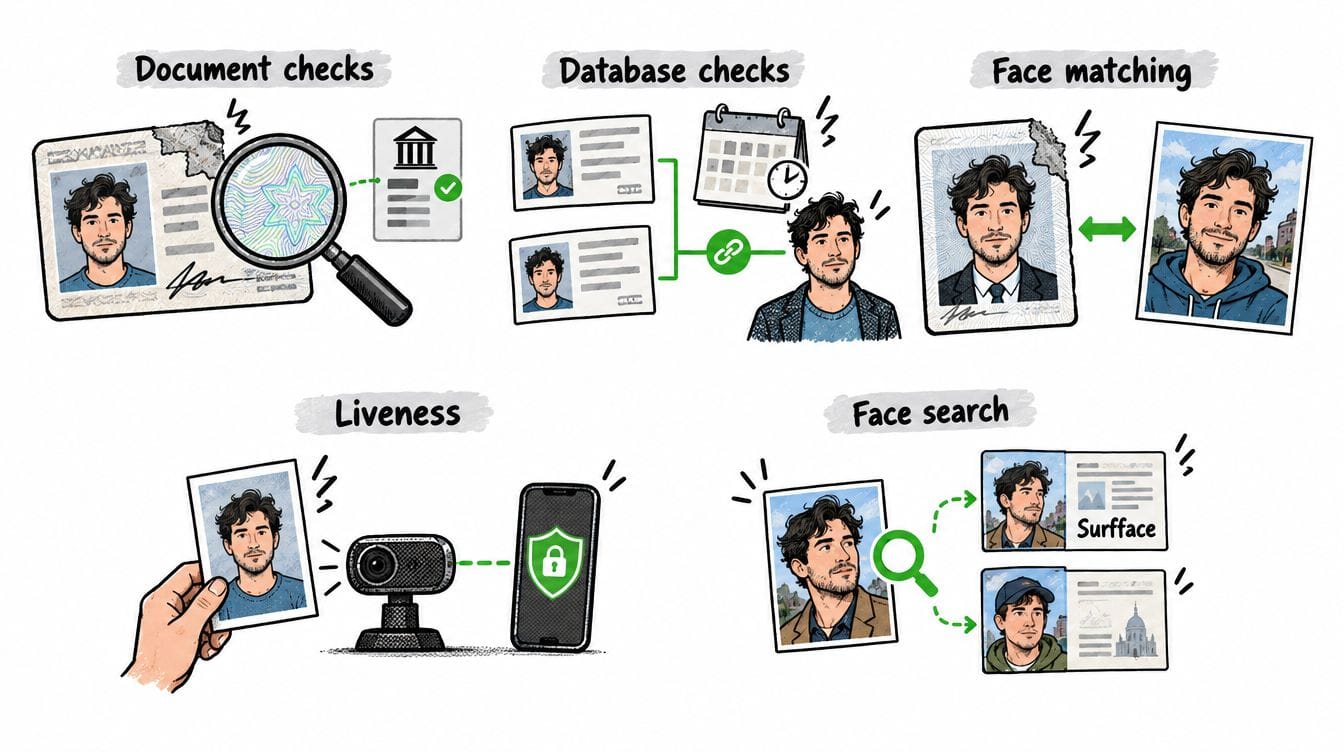
Each method addresses part of the problem. The matrix below shows what it checks, where it can fall short and how to strengthen the workflow.
How attackers attempt to bypass verification
Common attempts exploit gaps between these checks:
- Fabricated evidence: Altered documents and matching images support a false identity claim.
- Identity theft: Genuine documents and personal details belonging to someone else are reused.
- Presentation attacks: Photos or recordings are presented to the camera instead of the applicant.
- Injection attacks: Manipulated media enters the process in place of a trusted capture.
- Social engineering: A genuine person is deceived into completing verification for an attacker-controlled account.
Strengthen the process with independent attribute validation, protected capture and trained review of significant inconsistencies. Biometric comparison alone does not prevent injection attacks. Reviewers also need evidence outside the submitted application when investigating suspicious claims.
How OSINT strengthens identity verification and KYC
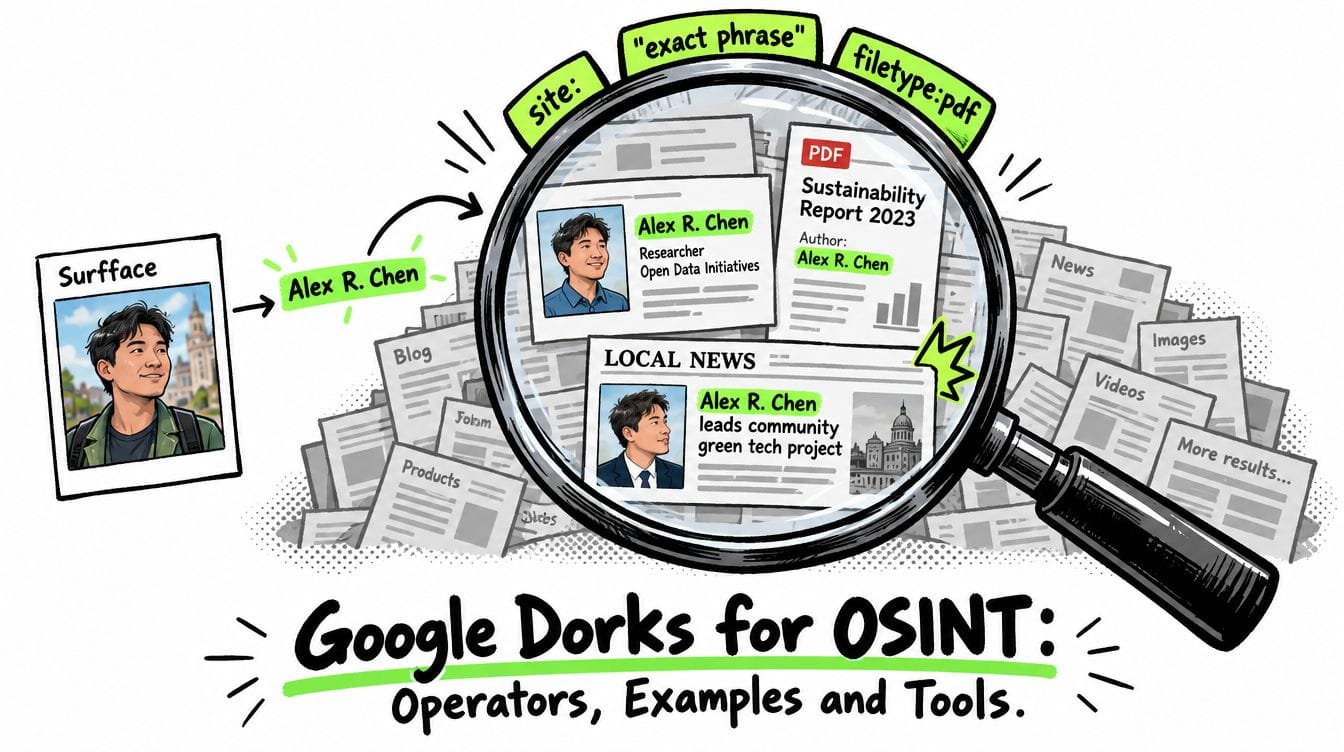
Open-source intelligence (OSINT) uses publicly available information to investigate identity claims. Reviewers examine public records, professional profiles, news and other relevant sources to corroborate information or identify contradictions.
This external research is already part of business verification workflows. Persona’s reports, for example, supplement applicant submissions with public records, media mentions, watchlists and other sources.
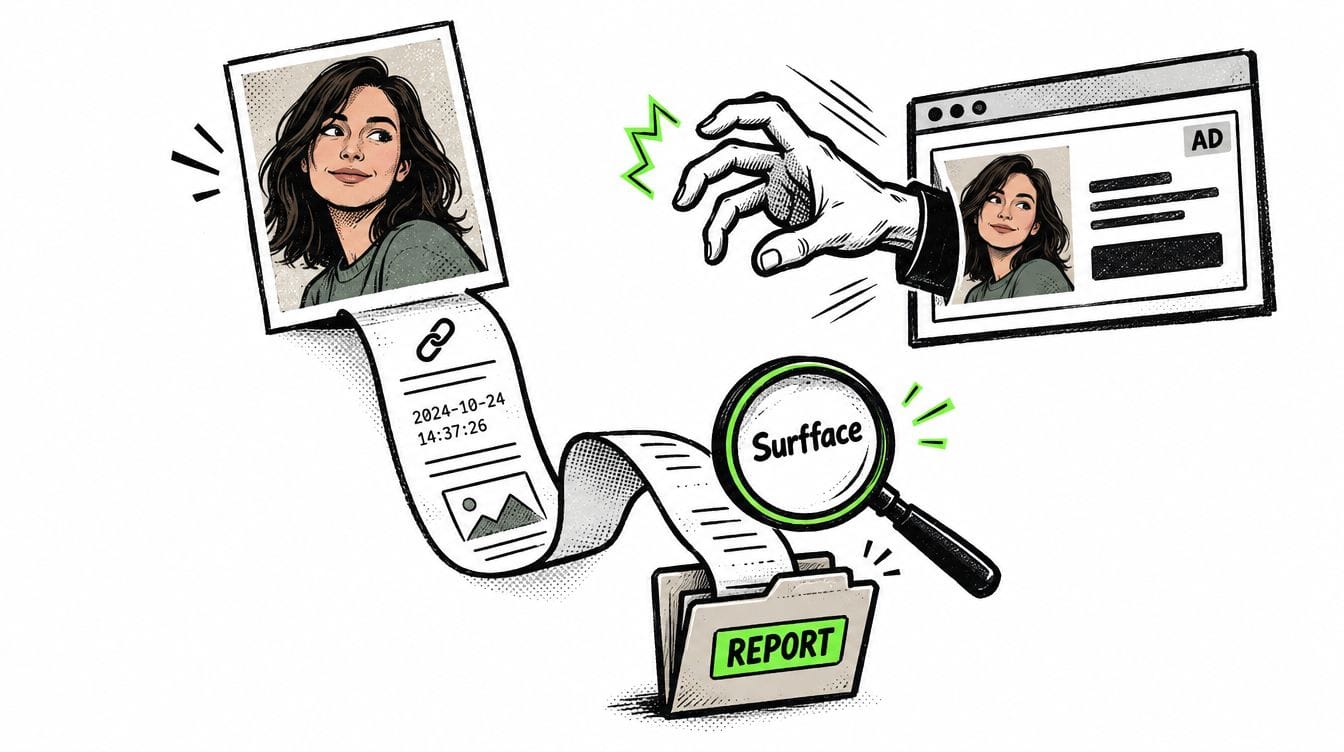
Face search can contribute a useful discovery lead. Suppose an applicant introduces himself as “Alex, architect in Boston.” His photograph appears on an established professional page under another name. That discrepancy gives a reviewer a specific claim to investigate. It does not settle the case: the caption could be wrong or the face could belong to a lookalike.
When government database access is limited, OSINT can provide additional context and help test submitted claims. Assess source reliability and independence: five sites copying one biography do not provide five separate confirmations. A limited online footprint is not evidence of fraud.
Use OSINT alongside appropriate document, liveness and authoritative checks. Surfface makes the face-led discovery step accessible when a photograph is your best starting point.
Start with Surfface when you only have a photo
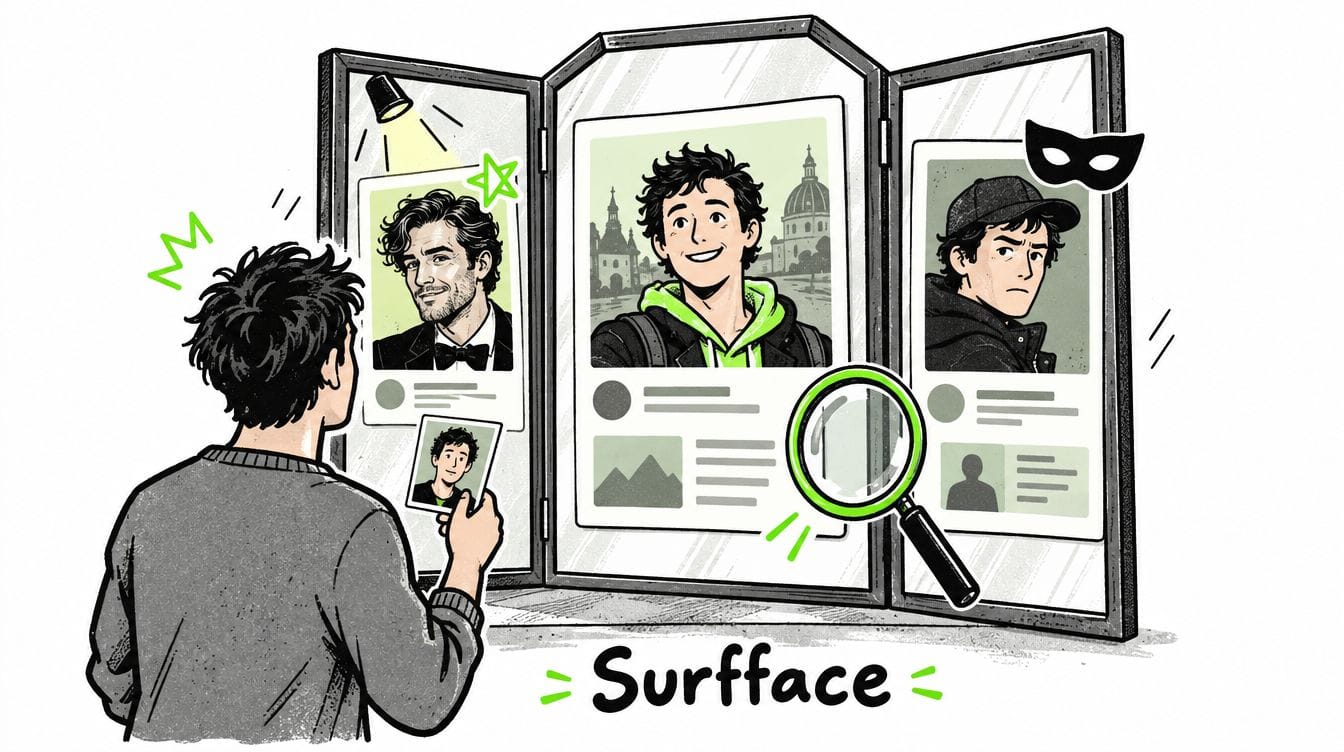
A name-based lookup is difficult when the name is missing or invented. Surfface lets you upload a face photo and search for possible public-source matches.
Its face search Orchestrator combines Surfface’s own index with major image search engines and third-party tools. Potential sources include social profiles, news, blogs and available U.S. public records such as mugshots and sex offender registries.
How to check public identity clues from a photo
- Upload a clear photo. Avoid heavy filters and crop out other people.
- Search free. Review possible matches as investigative leads.
- Unlock promising sources. Use paid credits to inspect original pages.
- Cross-check details. Compare names, locations and dated photos across independent sources.
- Verify account control. Contact the person through an established channel when appropriate.
No matches does not prove that a profile is genuine. See our guide to identifying fake social media profiles. If your own photos are being reused, follow our online impersonation check.
Surfface prohibits searches involving minors and restricts access where required. Public records may be inaccurate or outdated. A mugshot does not prove conviction. Do not use results for employment, housing, credit or insurance screening.
Identity verification service providers and pricing
For businesses onboarding applicants, public-source research complements a configured verification workflow. Choosing a provider means comparing both its checks and its commercial terms.
The table covers four providers, not the entire market.
What identity verification actually costs
A lower unit price can still mean a higher bill at low volume. For 20 billable checks, Veriff’s Essential minimum is $49 and Sumsub’s Basic minimum is $149. Twenty Stripe document-and-selfie checks cost $30 before introductory allowances.
These illustrative calculations exclude taxes, add-ons and negotiated terms. The feature bundles differ.
Measure cost per successfully onboarded legitimate customer, including manual review and abandonment. The unit price alone does not capture the cost of a difficult verification process.
How to choose identity verification software
Evaluate providers against your users and risks:
- Coverage: Supported countries, documents and user populations.
- Fraud resistance: Document validation, liveness and capture-integrity controls.
- Recovery: Approved retries, accessibility support and manual review.
- Privacy: Collection, storage, retention and deletion controls.
- Integration: Hosted flows or custom application integration.
- Auditability: Check results, failure reasons and documented decisions.
Pilot representative devices and document types. Measure completion, genuine-user rejection and review workload. A headline accuracy figure cannot describe every workflow.
Whatever provider you choose, verification has a scope and a date. A previously verified account can later be compromised. Assess identity, current account control and the credibility of individual claims separately.
FAQ
Identity verification establishes whether a person is the legitimate owner of the identity they claim. A robust process checks both the evidence and its connection to the applicant: whether an identity document is authentic and valid, whether its details match reliable records and whether the person presenting it matches the document holder. Document validation, face comparison and liveness detection answer different questions. Confidence depends on their combined results, the quality of the evidence and the safeguards against impersonation.
A photo can provide a starting point for investigating identity but cannot establish legal identity by itself. Surfface searches for possible face matches across public sources, including social profiles, news and available U.S. public records. If promising matches appear, unlock the source links with paid credits and inspect the original pages. Corroborate names, locations and other details using independently sourced evidence. Distinguish the person pictured from the person contacting you: a scammer can use a real person’s photographs and biography.
Face verification typically performs a one-to-one comparison between a captured face and a specific reference portrait, such as the photo on an ID. Face search performs discovery across many indexed images to identify possible candidates. Verification evaluates a claimed identity connection while search generates leads for further investigation. Neither automatically establishes liveness or account ownership. A similarity score measures a system’s assessment of resemblance and should not be interpreted as a probability of identity unless that interpretation has been explicitly validated.
Pricing depends on the checks included, verification volume and billing rules. Published examples include Veriff Essential at $0.80 per verification with a $49 monthly minimum, Stripe Identity document-and-selfie checks at $1.50 and Sumsub Basic at $1.35 with a $149 monthly minimum. Persona Essential starts at $250 monthly with a 12-month minimum contract term. These are different service bundles rather than equivalent checks. Compare minimum commitments, chargeable outcomes, add-ons and manual review costs. For businesses, measure total cost per successfully onboarded legitimate customer.
Surfface can help when your goal is to investigate someone’s public identity clues from a photograph. Its face search Orchestrator combines multiple search sources and methods to discover possible matches. Persona powers identity verification workflows configured by businesses, which may include document validation, selfie comparison and liveness checks. The tools can support different stages of an investigation but their results are not interchangeable. Surfface does not authenticate identity documents or replace a required Persona verification process.
If you cannot complete Persona face verification, contact the business that requested it and ask about an approved alternative, manual review or accessibility accommodation. That business controls the requirements and the final decision. For an authorized retry, check camera permissions, use even lighting, reduce glare and follow the instructions with your own genuine document and unedited live capture. Explain any document mismatch or technical problem to support. Another person’s face, manipulated media and a Surfface result cannot legitimately substitute for the required check.
No. A face match concerns resemblance or identity linkage, not honesty, intentions or the accuracy of someone’s claims. Even a correctly identified person may be impersonated through a stolen account or copied photographs. Assess identity, current account control and the specific claim separately. Review original sources, check dates and seek independent corroboration while retaining contradictory evidence. Public-record matches also require context: a mugshot does not establish a conviction. Do not rely on a face search as the sole basis for important decisions.

Stan leads product marketing at Surfface, bringing a mix of experience in OSINT and private investigations, along with expertise in digital marketing and product management.