OSINT Face Search: Find People From a Photo
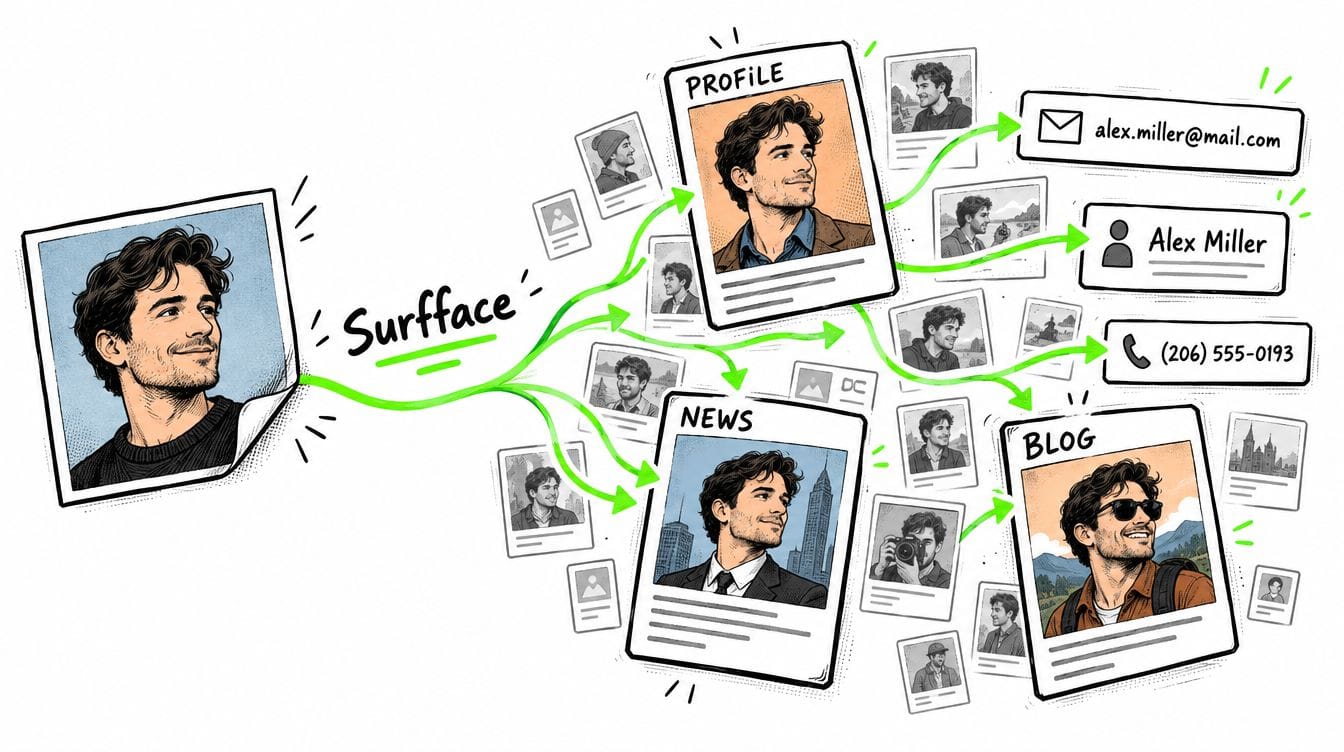
OSINT face search uses a face photo to discover possible matches in public online sources. Start with Surfface to look for photos, profiles and U.S. public-record leads then verify each promising result at its original source. A match is a lead. It becomes useful intelligence when independent evidence supports the connection.
A name can be invented. A username can change. A photo can give you another route into an investigation.
The challenge is deciding whether the person you found is actually the person you are researching.
What is OSINT face search?
OSINT means open-source intelligence: information collected from publicly available sources then assessed to answer a question.
Face OSINT starts with a photograph rather than a name, email address or phone number. It can uncover pages showing a similar face and provide clues such as names, usernames, organizations and publication dates.
Those clues support investigations into impersonation, photo misuse and misleading identities. They do not automatically establish who controls an account.
Keep three questions separate:
- Where does this photo appear?
- Do different photos show the same person?
- Does that person control the account being investigated?
A stolen portrait may answer the first question while leaving the third unresolved.
OSINT image search vs. face search
Reverse image search alone is not enough for a thorough OSINT face investigation. It is useful for finding copies, edited versions and visually similar images. But the person you are researching may appear in a completely different photograph with different clothing, lighting, surroundings or age. Finding the original photo and finding other photos of the same person are different tasks.
That is why you need a dedicated face search engine. Specialized face matching focuses on facial characteristics to retrieve possible matches across different photographs. General image search can sometimes uncover the same person too but it should not be your only discovery method. Use it alongside face search to investigate logos, signs, clothing and background details. Our guide to reverse face search vs. reverse image search explains how these methods complement each other.
The searchable index matters as much as the matching technology. Even a strong face-matching algorithm cannot retrieve a photograph from a source its search system does not cover.
Surfface goes beyond general web face matching with specialized indexes for U.S. mugshots and criminal records with face photos and U.S. sex offender registries with faces. These include more than 22 million mugshot and criminal records with faces and over 700,000 registered offender faces. This gives investigators an additional discovery route when a name is unknown, unreliable or an alias.
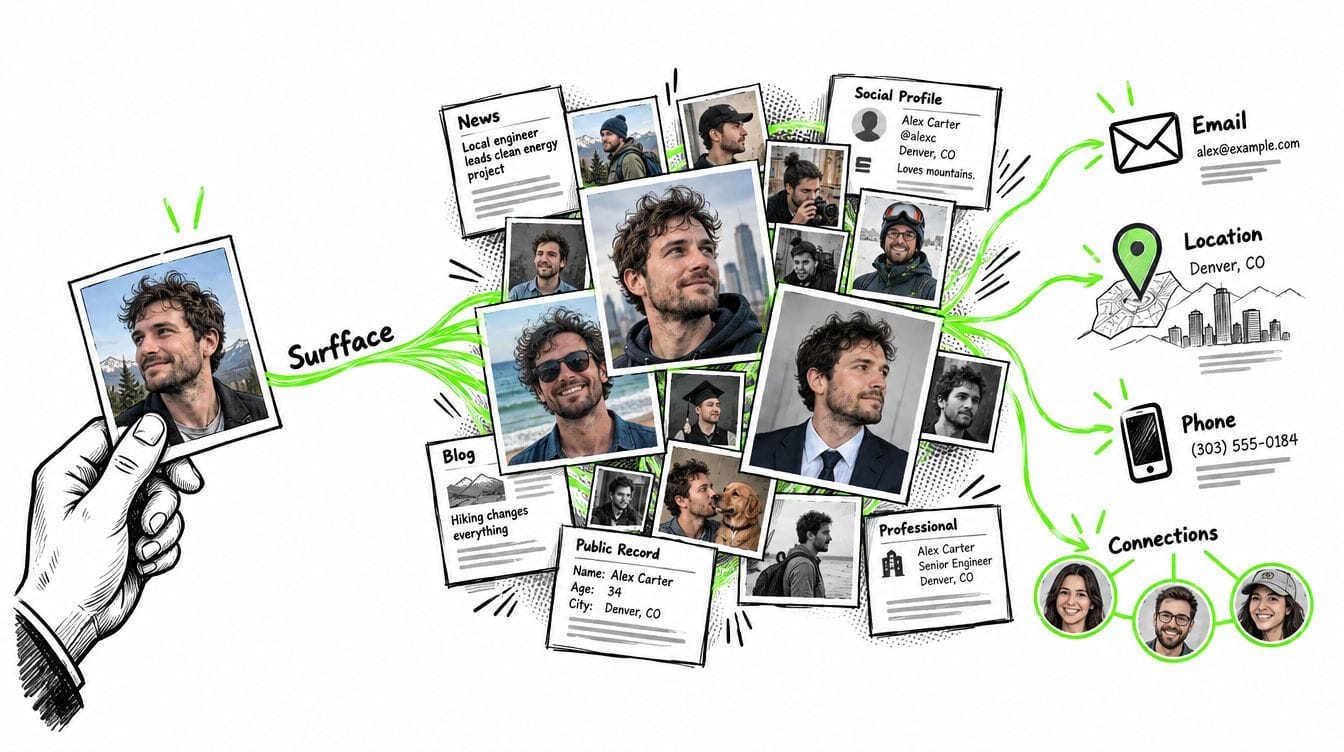
Combined with its face search orchestrator, this specialized coverage is a major advantage for investigators who use Surfface regularly: one photo can produce leads across public profiles, news and relevant U.S. record sources.
Finally, distinguish face search from face comparison. A comparison tool assesses photos you already have. It does not necessarily discover new photographs or search the web. Use search to find candidates then corroborate them through original sources and independent identity clues.
Start an OSINT face search with Surfface
When your only identity clue is a photo, Surfface is a practical starting point.
Surfface is a face search orchestrator. It combines its own index with major image search engines and third-party face and image search tools in one place.
It helps discover faces across news, blogs, public social profiles and available U.S. public records including mugshots and sex offender registries. Coverage varies by source and jurisdiction.
Start free and review possible matches. If you see promising results, unlocking the search requires paid credits. Source links let you inspect the original pages and verify the context behind each match.
A practical face OSINT workflow
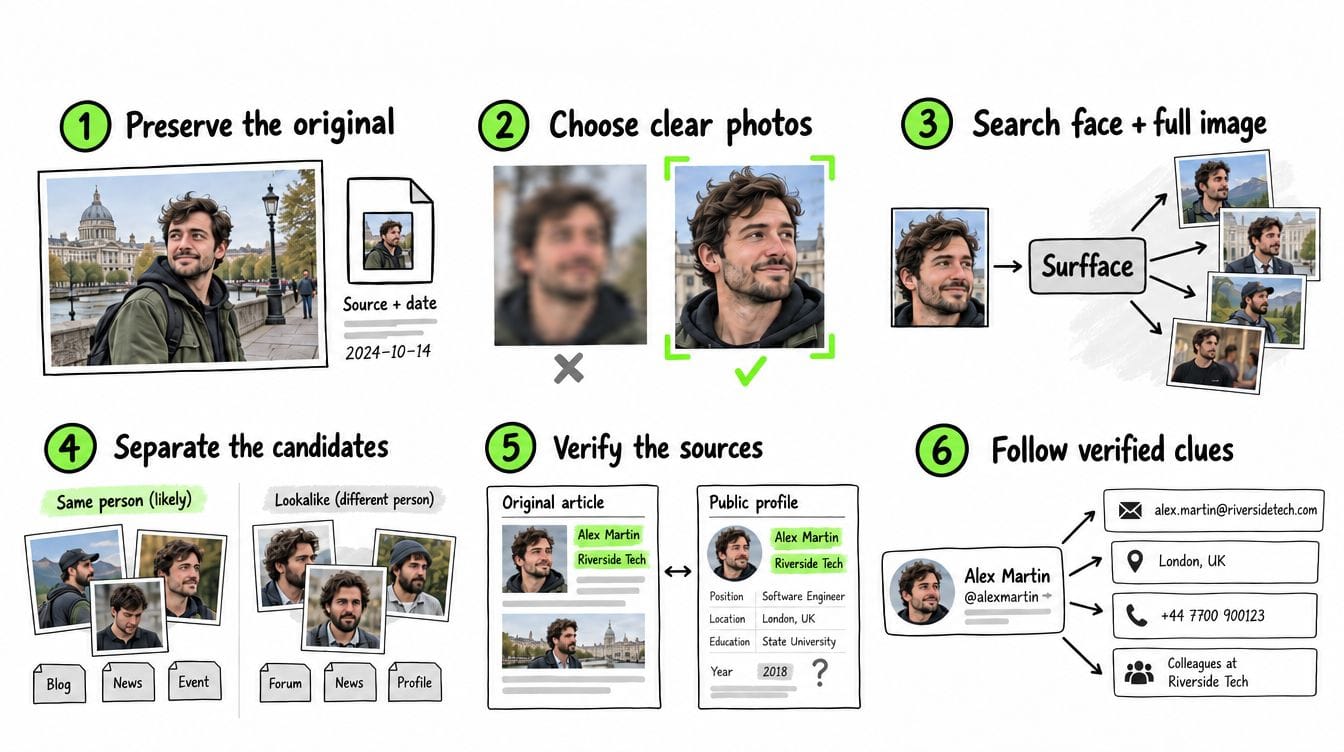
1. Preserve the original photo
Record where you obtained the image, its URL and the date you accessed it. Keep the original file.
For a video, save the relevant timestamp and extract several clear frames. For a group photo, make a separate crop of the person you are researching.
Keep both the full image and the crop. Background details may become useful later.
2. Choose clear images
Prefer visible facial features, even lighting and enough resolution to inspect details. Try another genuine photo if the first search is weak.
Avoid treating an AI-restored face as evidence. Restoration may invent details that were absent from the original.
NIST’s evaluations show that image quality affects missed matches and that false matches can occur even with high-quality images.
3. Search the face and the full image
Run the face search then search the uncropped image for contextual clues.
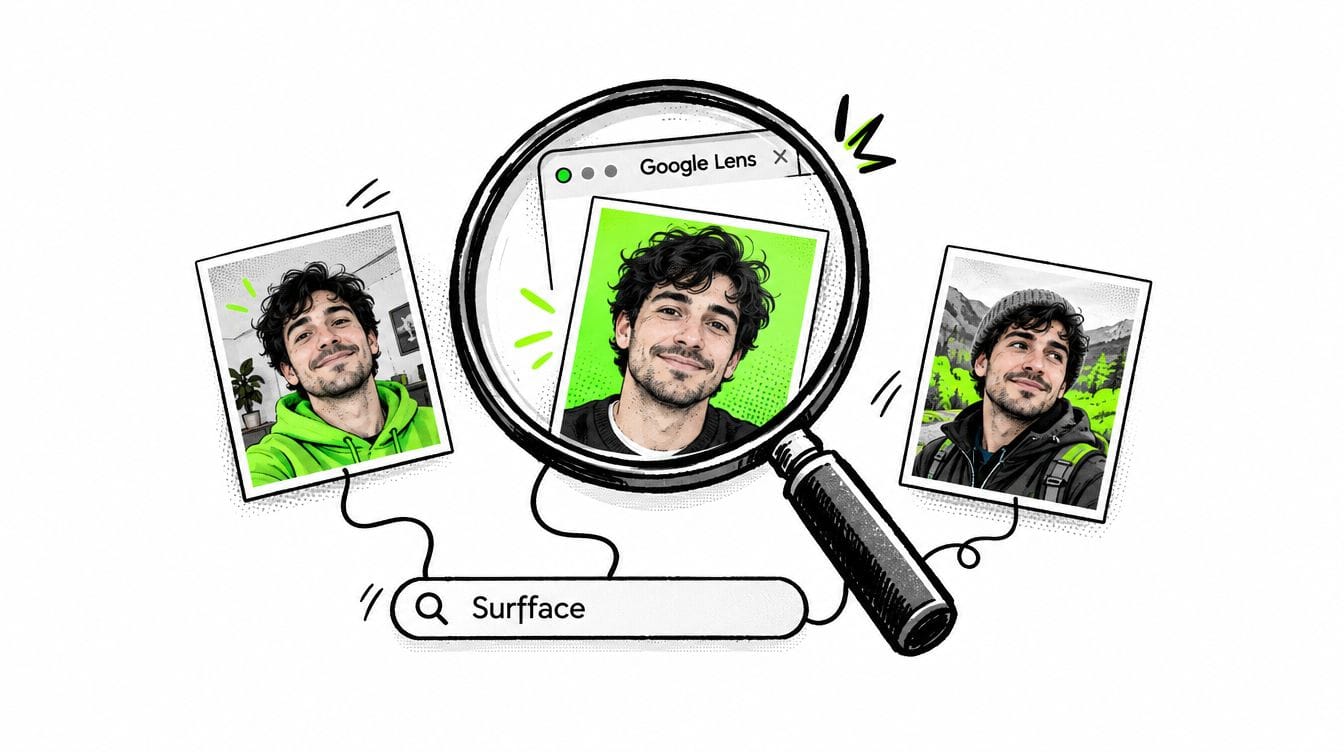
In Google Lens, inspect every relevant results tab available to you. Do not stop at “All.” Different views may surface useful pages that the default view misses.
Treat AI-generated identity summaries as hypotheses. Follow their source links before recording a name as a finding.
4. Build separate candidate records
For each promising result, record:
- Source URL and access date
- Name or username shown on the page
- Publication date and relevant context
- Supporting details and contradictions
- Whether the result repeats another source
Do not merge every similar face into one identity. Keep candidates separate until evidence supports combining them.
Five sites reposting one caption provide one underlying claim.
5. Verify identity and account ownership
Look for agreement across independent sources: an organization biography, an event caption and a public profile linking to the same organization.
Check dates, locations and distinctive visible details. Consider evidence that contradicts your theory too.
Example: A profile claims to belong to “Daniel in Miami.” A face search finds the portrait on a photographer’s portfolio under another name. That supports possible photo reuse. It does not identify the profile operator or prove fraud by itself.
A similarity percentage is not automatically the probability that two people are the same.
6. Pivot from verified clues
Once a name or username is supported, use it to search for further public sources. Simple queries can narrow the investigation:
"Full Name" "Organization""username" "event name"site:example.org "Full Name"
Keep a note explaining each connection: “This profile links to the same organization named in the event caption.”
For tools that investigate other identifiers, see our practical OSINT tools guide.
Real investigations where face search helped
Daniela Klette: an old photo produced a new lead
Reuters reported that journalists researching Daniela Klette used PimEyes to search a wanted-notice photograph. Results showed an older woman using another name in Berlin’s capoeira community.
Bellingcat researcher Michael Colborne also tested the images with face comparison tools. The reporting did not establish that the journalists’ findings caused her arrest.
The practical lesson: face search can connect different photographs across decades then guide further research.
January 6: facial leads within a larger investigation
In GIJN’s account of the Capitol investigation, Bellingcat investigator Giancarlo Fiorella used face search for identifying individual rioters.
The broader effort also involved preserving videos, examining symbols and researching public posts.
The lesson is to combine facial leads with contextual evidence and preserve the material supporting each conclusion.
What can make an OSINT face search misleading?
- Lookalikes: A convincing resemblance can still involve two different people.
- Recycled claims: Search results may repeat an incorrect caption across multiple websites.
- Wrong account attribution: A photo of someone does not prove they operate the account displaying it.
- Incomplete coverage: Private, deleted, unindexed or excluded content may be unavailable. No results does not mean no online presence.
- Public-record ambiguity: A mugshot does not establish a conviction. Verify identity, record status and context at the official source.
Use permitted sources and respect access restrictions. Surfface prohibits searches involving minors and explicit content. Do not use findings for harassment or FCRA-regulated decisions such as employment, credit or tenant screening.
FAQ
OSINT face search uses a photograph to discover possible images of the same person across public online sources. Unlike ordinary reverse image search, specialized face search can find candidates in different photographs rather than only copies of the uploaded image. Researchers then assess the original pages, source reliability and independent identity clues to determine whether a match is credible.
A photo can uncover identity leads even without a name or username. Start with Surfface using a clear face image and try additional genuine photos if available. Preserve the full image for contextual searches. Promising results may reveal names, profiles or public records but identification requires corroboration. A similar face or an isolated caption is not enough to establish identity.
You can start a Surfface search free and review possible matches. If the results look promising, paid credits unlock source links so you can examine the original pages and verify their context. Source access is essential for serious investigation: a thumbnail alone cannot establish who is pictured, when the photo was published or whether the accompanying claims are reliable. Payment does not guarantee identification.
Reliability depends on facial visibility, resolution, lighting, age differences, the matching method and source coverage. Two errors matter: retrieving a lookalike and missing the correct person. A similarity score is not automatically a probability of identity. Corroborate candidates through independent sources and record contradictions. Multiple websites repeating the same photo or caption do not provide independent confirmation.
No. Face search may help identify the person pictured but that person could be an impersonation victim. Identifying an account operator requires separate evidence connecting them to the account. Publicly linked websites, consistent account histories and corroborated statements can support that investigation. Finding a portrait under another name suggests possible photo reuse but does not by itself prove fraud or reveal who controls the account.

Stan leads product marketing at Surfface, bringing a mix of experience in OSINT and private investigations, along with expertise in digital marketing and product management.